
Affiliate disclosure: some links are affiliate links — as an Amazon Associate we earn from qualifying purchases, at no extra cost to you. Full disclosure.
A regulator has one job: reduce a tank’s higher pressure down to the lower, steady pressure a heater’s burner needs. Here’s how to pick one that actually matches your setup.

Matching Regulator Capacity to BTU
Regulators carry a maximum BTU rating, not just a fitting type. A regulator rated below your heater’s actual output can bottleneck fuel delivery. That shows up as a weak flame or reduced heat, which looks like a heater problem but isn’t. Always check the regulator’s rated capacity against your heater’s BTU output, not just whether the fitting threads on correctly.

Best for Standard Buddy-style heaters hose-connected to a 20 lb tank
- Integrated regulator and gauge
- QCC1 elbow adapter included
- Braided hose construction
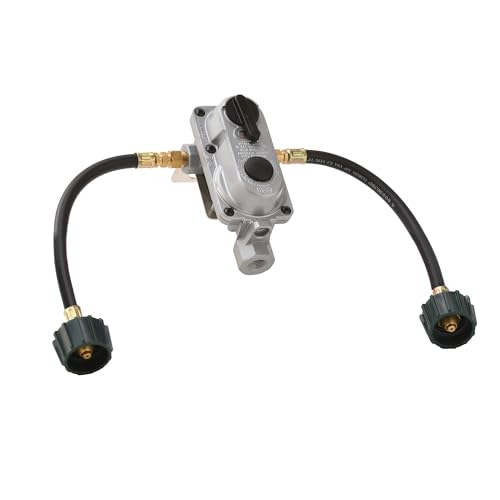
Best for RVs and setups running from two tanks with automatic switchover
- Two-stage regulation for stable pressure
- Auto changeover between two tanks
- Two 12-inch pigtail hoses included
Single-Stage vs. Two-Stage Regulators
A single-stage regulator reduces tank pressure to burner pressure in one step. That works fine for most portable heaters running from a single tank. A two-stage regulator does this in two steps instead. It delivers steadier pressure as a tank empties and its internal pressure naturally drops. Two-stage regulators show up often in RV systems, where consistent output matters more than simplicity.
Auto-Changeover Regulators for Two-Tank Setups
Some setups run from two tanks with an auto-changeover regulator. It switches to the second tank automatically once the first runs dry, with no interruption in gas flow. This adds real convenience for anyone who doesn’t want to manually swap tanks mid-use. It also adds a bit more complexity to the initial setup.
Signs Your Regulator Doesn’t Match Your Heater
- Weak flame despite a full tank — check the regulator’s rated capacity against your heater’s BTU output.
- Inconsistent output as the tank empties — a single-stage regulator on a nearly empty tank shows more pressure variation than a two-stage one.
- Fitting connects fine but gas flow feels restricted — a regulator rated for a much lower BTU appliance can cause this, even with a correct physical fit.
Where Regulators Fit Into a Full Hose Setup
Most portable heater hose kits already include a built-in regulator. That’s the simplest option for most buyers. A standalone regulator upgrade makes sense specifically when you’re building a custom setup, running two tanks, or troubleshooting a mismatch on an existing hose. See our tanks, hoses and accessories guide for how regulators fit into the broader fuel-supply picture.
Do You Need a Regulator at All?
If your heater ships with a complete hose-and-regulator assembly already attached, you don’t need to buy one separately. A standalone regulator purchase makes sense mainly for replacing a damaged part, upgrading from a single-stage to a two-stage design, or building a custom hose run for a bulk tank. Check what’s already included with your heater before assuming you need an extra part.
Regulators and Cold Weather
A regulator’s job gets slightly harder in genuinely cold conditions, since a tank’s internal pressure drops as temperature falls. This isn’t a regulator defect. It’s a normal characteristic of how propane behaves in the cold. A two-stage regulator generally handles this better than a single-stage one, since it’s designed to compensate for pressure swings more precisely across a wider range of conditions.
Freeze-Ups: A Regulator Symptom, Not Usually a Regulator Fault
Frost forming on a regulator or the top of a tank during use is a known effect of high-demand draw in cold weather, not typically a sign the regulator itself has failed. Liquid propane absorbs heat as it vaporizes to feed the burner, and in cold conditions with high demand, that heat absorption can drop the regulator’s temperature enough to frost over. If this happens regularly, running the heater on a lower setting, or switching to a larger tank with more surface area to draw from, usually resolves it without needing a new regulator.
Buying a Replacement vs. a New Hose-and-Regulator Assembly
If your existing regulator is part of an integrated hose assembly and it fails, replacing the whole assembly is often simpler and not much more expensive than sourcing a standalone regulator to fit the existing hose. Standalone regulators make more sense when you’re building a custom setup from separate parts, or when the hose itself is still in good shape and only the regulator has an issue.
Regulator Certification: What to Look For
A quality propane regulator carries a CSA or UL listing mark on its housing. That mark means it’s been independently tested for propane service at its rated pressure and BTU capacity. It isn’t just a similar-looking part borrowed from a different gas or application. This matters more than it might seem. A regulator sits at the point where high tank pressure steps down to the low pressure a burner needs. An untested part in that role is a real safety concern, not just a performance issue. Check for this listing on the regulator body or its packaging before buying, especially for a standalone replacement rather than one bundled into a name-brand hose kit.
Step-by-Step: Installing a Standalone Regulator
Start with the tank valve fully closed and no fuel flowing. Thread the regulator’s tank-end fitting onto the tank by hand. QCC1 is hand-tight only. A POL fitting needs a wrench. Connect the outlet side to your existing hose or directly to the heater, following the regulator’s instructions. Open the tank valve slowly rather than all at once, letting the regulator settle into its normal range gradually. Brush a soapy-water solution over every new connection before lighting the heater. Bubbles mean a leak. Tighten that fitting and retest before you proceed.
Testing a Regulator You Suspect Has Failed
A regulator that’s genuinely failed usually shows a clear symptom: no gas flow at all, a hissing sound at the regulator itself, or output that stays weak no matter the tank level or heater setting. Before replacing one, rule out simpler causes first — a nearly empty tank, a kinked hose, or a fitting that isn’t fully seated all produce similar symptoms to a failed regulator, and are worth checking before buying a replacement part unnecessarily.
Quick Recap
Match the regulator’s BTU rating to your heater. Choose single-stage for a simple setup. Choose two-stage for an RV or dual-tank system. Check the simple causes first before assuming a regulator has failed. That covers the decision for almost every buyer, whether you’re setting up a single portable heater or a two-tank RV system. A regulator is a small part of the overall cost, but getting it right prevents most of the "weak flame" complaints owners run into with a new hose setup.