
Affiliate disclosure: some links are affiliate links — as an Amazon Associate we earn from qualifying purchases, at no extra cost to you. Full disclosure.
A garage is one of the hardest spaces to heat well. It's usually uninsulated or poorly insulated, has a large door that leaks heat, and sits on cold concrete. Picking the right propane heater for garage use means matching the heater type and BTU output to those specific conditions, not just buying the highest-rated model available.
Most people searching for a propane heater for garage use are trying to solve one of two different problems: warming themselves briefly while grabbing tools, or warming the whole space for hours of real work. Those two problems call for genuinely different heater types, which is why the radiant-vs-forced-air decision below matters more than any single spec on a listing page.
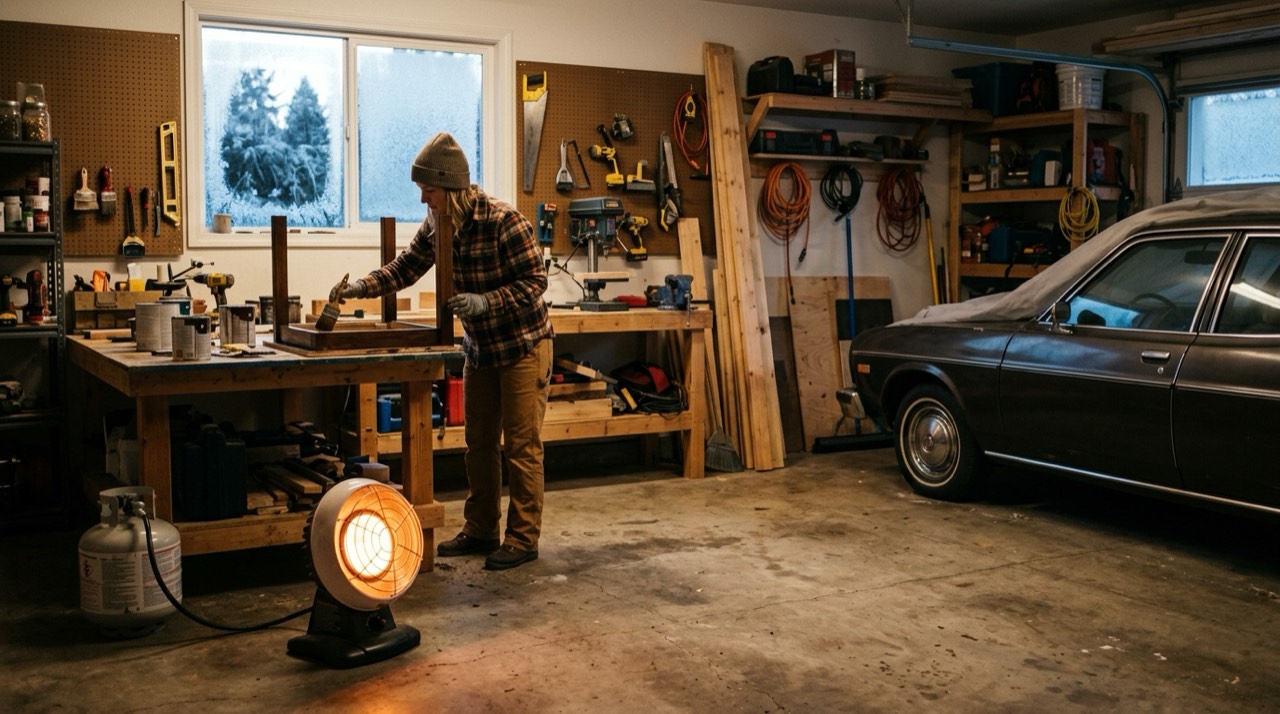
Top 3 Recommended
Radiant Heater vs. Forced Air Heater: Which Propane Heater for Garage Work?
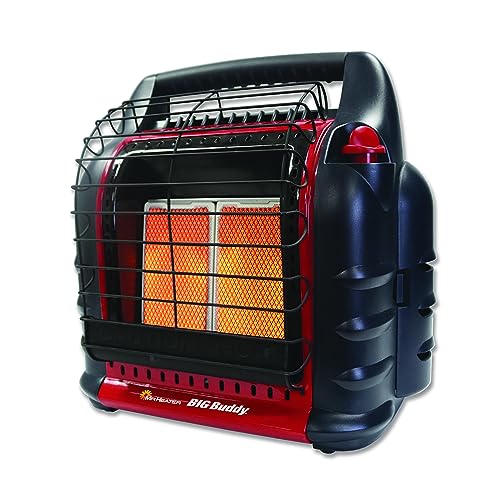
The choice between a radiant Buddy-style heater and a forced-air unit comes down to how you use the garage. If you're in and out quickly — grabbing tools, working on one spot for a few minutes — a radiant heater like the Mr. Heater 18,000 BTU Big Buddy warms you directly and starts working the moment it's on. If you're working in the garage for hours and need the whole space to actually warm up, a forced-air heater like the Dyna-Glo RMC-FA150DGD or the DEWALT 68,000 BTU Forced Air Heater is the better investment, since it raises ambient air temperature rather than just warming what's directly in front of it.
What Size Propane Heater for a Two-Car Garage? BTU Sizing by Square Footage
A single-car garage used occasionally is often well served by an 18,000 BTU Big Buddy on its highest setting. A two-car garage, especially one used as an active workshop for hours at a time, typically needs a forced-air heater in the 50,000–100,000+ BTU range depending on insulation.
BTU Needs for a Genuinely Uninsulated Garage
As a rough guide, uninsulated garages need considerably more than the 20–30 BTU-per-square-foot guidance used for a sealed interior room — often 40+ BTU per square foot for a genuinely uninsulated space. Our BTU sizing calculator can work out a specific number based on your garage's square footage and insulation level.
Venting a Garage for a Propane Heater: Ventilation and Carbon Monoxide Risk
Ventilation requirements differ sharply between radiant and forced-air heaters in a garage setting. An indoor-safe radiant heater with an oxygen depletion sensor can run with the garage door closed, though manufacturers still recommend cracking a window or the door slightly for airflow. A forced-air heater is outdoor-use-only and needs active ventilation meeting the manual's stated minimum — typically requiring the garage door to be open a specific amount, not just "cracked." Running a forced-air heater in a sealed garage is a genuine carbon monoxide risk regardless of how cold it is outside. See our indoor safety guide for the full picture on ventilation and detection.
Clearance to Combustibles and a Permanently Vented Heater
Indoor-safe radiant heaters used in a garage are generally built to the ANSI Z21.11 safety standard. OSHA sets workplace CO exposure limits for a garage used as a workshop. The CPSC also publishes seasonal safety warnings on carbon monoxide poisoning from portable heaters used in garages specifically. NFPA 58, the national LP-gas code, sets clearance to combustibles and ventilation requirements that most local fire codes reference directly, and CSA certification confirms a specific model was independently tested against it. A permanently vented heater, which exhausts combustion byproducts outside the structure, avoids the ventilation question a portable unit still has to answer.
Running a Propane Line to a Tank Top Heater or Thermostat-Controlled Cabinet Heater
For a garage used as a primary workshop through a full heating season, some owners opt to run a fixed propane line to a permanent wall-mount, tank top heater, or vent-free cabinet heater — often with a built-in thermostat, like ProCom's cabinet line — rather than relying on a portable unit and swappable tanks. This is a bigger project than plugging in a portable heater — it typically requires a licensed plumber or gas fitter, and many local codes require professional installation and permitting for a fixed gas line into a structure. It's worth the investment only if the garage is genuinely a year-round workspace; for occasional weekend use, a portable heater and a tank remain far simpler. See our wall-mount and cabinet heater guide for the installation-focused details.
Propane Tank Size and Fuel Consumption: A 20-lb Propane Tank vs. 100 lb Tank
A standard 20-lb propane tank works fine for a portable radiant heater used occasionally, but a forced-air heater running at 100,000+ BTU burns through a 20-lb tank in a few hours, a fuel consumption rate worth planning around before buying. Garages used as a regular workshop through winter typically benefit from a 100 lb tank connected via a longer hose, both to reduce how often you're swapping tanks and because larger tanks are often more cost-effective per gallon when refilled rather than exchanged. Our tanks and accessories guide covers tank sizing and refill-versus-exchange economics.
Propane vs. Electric Heaters for a Garage
Electric space heaters are a common alternative for garage heating, and the choice often comes down to what's already available. If the garage has a dedicated high-amperage circuit, an electric heater avoids the fuel logistics of propane entirely. If the garage's electrical service is limited — a common situation in older homes and detached garages — a propane heater doesn't compete with other circuits for power and can deliver far more BTU output than most electric heaters at a comparable price point. Propane also has the advantage of working during a power outage, which matters if garage heat is a genuine necessity rather than a convenience.
Propane vs. Diesel Heaters for a Garage
A diesel parking heater — more commonly associated with RVs and vans — is occasionally used in a garage setting too, particularly by owners who already have diesel fuel on hand for a vehicle. Diesel heaters typically need a more involved installation than a plug-and-play propane forced-air unit, including exhaust venting, and they're less common in the garage-heating category specifically. For most garage use cases, a propane forced-air or radiant heater remains the simpler, more established choice. See our diesel heater guide if diesel is a genuine option for your situation.
Garage Heater Safety Checklist
- Confirm the heater's rating matches your ventilation setup — indoor-safe radiant heaters can run with the door closed; forced-air heaters need active ventilation per the manual.
- Keep the heater clear of stored items, chemicals and vehicles — garages accumulate flammable materials and fuel vapors that need real clearance from an open-flame heater.
- Install a battery-backed carbon monoxide detector (CO detector) in the garage regardless of which heater type you use.
- Never leave a forced-air heater running unattended — these are not built for the kind of continuous, unattended operation an indoor-safe radiant heater might be rated for.
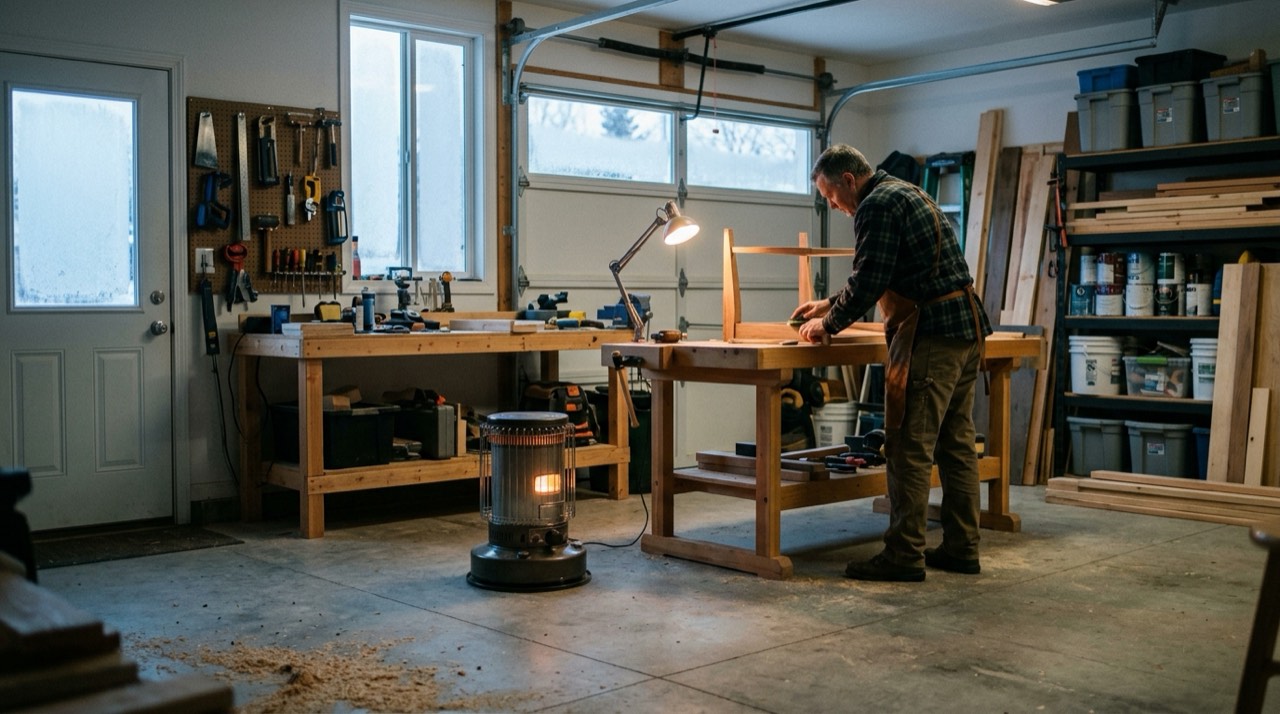
Insulation R-Value Matters More Than Heat Output or Heater Choice
Before buying a bigger heater, it's worth checking whether basic insulation improvements — and the garage's overall insulation R-value — would solve the problem more cheaply.
A Worn Garage Door Seal Is the Biggest Heat-Loss Point
A worn garage door seal is one of the most common heat-loss points; weatherstripping around a garage door, insulating an uninsulated door panel, and sealing obvious drafts around windows and the door frame can meaningfully reduce the heat output needed to hold a comfortable temperature. Owners who upgrade a garage door's insulation before buying a heater frequently find they can get away with a smaller, cheaper heater than they originally budgeted for — the heater and the building envelope work together, not independently. This is worth doing before buying rather than after, since it directly changes which heater size is actually the right recommendation for your specific garage.
Noise Level and Comfort During Long Workshop Sessions
If you spend hours in a garage workshop rather than just passing through, the noise profile of a forced-air heater is worth factoring into the buying decision alongside BTU output. The combustion fan runs continuously and is commonly compared to a shop vacuum or small generator, which some woodworkers and mechanics find fatiguing over a long session. A radiant Big Buddy runs silently by comparison, though it won't raise the room's ambient temperature the way a forced-air unit does. Some workshop owners split the difference by using a forced-air heater to bring the space up to temperature quickly at the start of a session, then switching to a quieter radiant heater to maintain comfort once the room has warmed.
Placement Within the Garage
Where you position a garage heater affects both safety and performance. A forced-air heater works best positioned to blow across the largest open area of the garage rather than into a corner, and needs clearance from parked vehicles, stored fuel, and flammable materials per its manual. A radiant heater performs best positioned so its heat path falls on the workbench or area you're actually using, rather than centered in open floor space. Both heater types should sit on a stable, level surface — cold concrete floors are fine for either, but avoid placing a heater where it could be knocked over by foot traffic or a vehicle backing in.
Using a Generator to Power a Forced-Air Heater
Because forced-air heaters need electricity for their ignition system and fan, a garage without power — during construction, a renovation, or an outage — needs a generator to run one. Most forced-air heaters have modest power draw for their ignition and fan motor, well within the capacity of a small portable generator, but it's worth checking the specific heater's power requirements against your generator's rated output before assuming compatibility, particularly for larger 100,000+ BTU models with bigger fan motors.
Seasonal Maintenance for a Garage Heater
Garage heaters, especially forced-air units, accumulate dust and debris faster than a heater used indoors, simply because garages generate more of both from projects, vehicles and general storage. Cleaning the fan intake and burner assembly periodically during heavy use, and doing a more thorough check before the first light of each new heating season, catches most of the "won't light" or "reduced output" complaints before they become a real problem. Checking the hose and regulator connections for wear is worth doing at the same time, since a garage's temperature swings between seasons can accelerate wear on rubber components faster than a climate-controlled space would.
Buying Considerations Specific to Garage Use
- Measure your actual garage square footage and insulation level rather than guessing — this is the single biggest factor in getting the right heater size the first time.
- Decide between radiant and forced-air based on how you use the space — brief visits favor radiant; extended work sessions favor forced-air.
- Check your electrical service if considering a forced-air heater, since most need a power source for ignition and the fan.
- Budget for tank size appropriately — a 20 lb tank is fine for occasional radiant use but inadequate for regular forced-air operation.
What Owners Report About Garage Heating
Across both radiant and forced-air categories, the most common regret owners report is undersizing — buying a smaller, cheaper heater and finding it inadequate for a genuinely large or poorly insulated garage, then having to either upgrade or run the heater constantly at maximum output. The opposite mistake, oversizing, is less commonly reported as a complaint but does show up as wasted fuel cost in long-term ownership reviews. Getting an accurate read on your garage's actual square footage and insulation level before buying, rather than guessing, is the single best predictor of long-term satisfaction across both reviews.
Home Workshop Heater vs. Detached Shop or Barn: Cold Start and an Overhead Heater
A garage attached to a house behaves differently from a fully detached workshop heater setup or barn, mostly because of shared walls and existing insulation. An attached garage often benefits from some residual warmth bleeding through from the house's heated interior, which can reduce the BTU needed compared to a detached structure exposed to outside temperature on all sides and gives a forced air heater a faster cold start each morning. A detached workshop or barn, with no shared walls at all, typically needs to be sized at the higher end of BTU-per-square-foot guidance, often with an overhead heater mounted clear of parked vehicles and foot traffic, and insulating the structure itself — walls, ceiling, and especially the largest door — pays off faster there than anywhere else in this category.