
Affiliate disclosure: some links are affiliate links — as an Amazon Associate we earn from qualifying purchases, at no extra cost to you. Full disclosure.
People shopping for a propane heater outdoor buying guide want to know one thing first: how far will the heat actually reach? An outdoor propane heater is built for open or semi-open air, not an enclosed room — the opposite design goal from an indoor-safe heater. A patio heater doesn't need an oxygen depletion sensor, because it's meant to run where fresh air is already circulating freely. Instead, it's built around a different set of priorities: how far it throws usable heat, how stable it is outdoors in wind, and how much space one unit can realistically cover.
Top 3 Recommended
Standing Patio Heater and Freestanding Heater: Reflector Dome, Heat Coverage Radius and Wheeled Base
The standing patio heater is the style most people picture: a tall pole unit with a wide dome reflector on top, usually rated around 40,000 to 50,000 BTU. Models like the BALI OUTDOORS Propane Patio Heater and the Giantex 50,000 BTU Standing Heater are typical of the category: stainless steel or powder-coated steel construction, a wide base or wheeled cart for stability, and a heat coverage radius that owners commonly report in the 10-to-15-foot range around the unit, depending on wind and ambient temperature. This freestanding heater style matters more than the raw BTU rating when you're deciding how many heaters a patio or deck actually needs — one standing heater comfortably warms a small seating area, but a larger outdoor dining space usually needs two or more positioned around the perimeter rather than one heater in the middle. Brands like Hiland, Fire Sense and Bluu all sell freestanding heaters in this same style and BTU range.
Mushroom Heater, Pyramid Heater and Tabletop Heater: Shapes to Know
Standing heaters come in a few recognizable shapes. A mushroom heater has the wide dome reflector described above, throwing heat down and outward in a broad circle. A pyramid heater swaps the dome for a tapered glass-tube column with visible flame running up the middle, trading a little coverage for ambiance. A tabletop heater is smaller still, sitting directly on a table rather than the ground — the right choice when floor space, not coverage, is the limiting factor. All three run on the same basic fuel and ignition principles; the shape mainly changes heat pattern and where the unit can physically go.
Tank Top Heaters: A Compact Alternative Using a Propane Regulator, Not a Standing Base
A tank-top heater screws directly onto a 20-lb propane tank through a regulator and valve, instead of standing on its own base. That makes it shorter, lighter and easier to store between uses. The Mr. Heater Original 540° 45,000 BTU Tank Top Radiant Heater is the clearest example: its swivel head throws heat across almost the full 360 degrees around the tank. Owners frequently mention swapping a standing patio heater for one of these and getting comparable warmth in a smaller footprint. The tradeoff is height — a tank-top unit sits much closer to the ground, so the heat pattern differs from a tall standing heater, and it suits a smaller huddle of chairs better than a wide dining table.
BTU Output and Heat Output: Sizing an Outdoor Heater in Square Feet
Outdoor heat dissipates fast, so BTU-per-square-foot rules of thumb for indoor rooms don't translate directly to a patio. As a rough guide published across most patio heater manuals, expect a 40,000–50,000 BTU standing heater to meaningfully warm a roughly 150–200 square foot area in mild-to-cool weather, with that radius shrinking in wind or genuinely cold conditions. Two smaller heaters spaced apart consistently outperform one large heater in the middle of a space, because outdoor heaters work by radiant warmth in their immediate vicinity rather than by warming the whole volume of air the way an indoor heater does. Our BTU sizing guide covers the math in more depth, including for enclosed porches where the physics changes.
Patio Heater Safety Features: Tip-Over Switch, Tilt Shut-Off and CSA Certification
Because a patio heater runs unattended outdoors, a tip-over switch and an automatic tilt shut-off valve are standard safety features worth confirming before buying rather than assuming. Reputable outdoor heaters carry a safety certification — CSA certification shows up specifically in the Giantex listing above, and UL (Underwriters Laboratories) is another recognized certifying body worth checking for on any standing heater. Third-party testing against a recognized safety standard means more than a manufacturer's own claim. Wind is the other practical hazard: a lightweight standing heater on a small base can tip in a gust, which is why most manuals recommend a weighted base or sandbag kit for anyone in a consistently breezy location.
Porch and Semi-Enclosed Spaces Are a Different Category
A patio heater is designed for open air, and running one in a fully or mostly enclosed space changes the safety picture. A screened porch, a covered patio with three walls, or any semi-enclosed structure needs different guidance than a fully open backyard — see our porch and screened-space heater guide for that specific scenario, including which heater styles are and aren't appropriate there.
Running Cost: How Long a 20-lb Propane Tank Lasts in a Patio Heater
A 50,000 BTU patio heater burns through a 20-lb propane tank noticeably faster than a smaller indoor-style heater. Using the standard conversion of roughly 21,600 BTU of usable energy per pound of propane, a 20-lb tank feeding a heater at full 50,000 BTU output lasts roughly 8–9 hours of continuous burn. Most people don't run a patio heater at full output continuously, and many models include a lower setting that stretches tank life considerably. It's still worth budgeting for tank refills more often than with a smaller camping or garage heater. Our tanks and accessories guide covers refill versus exchange options.
What Owners Report About Standing Patio Heaters
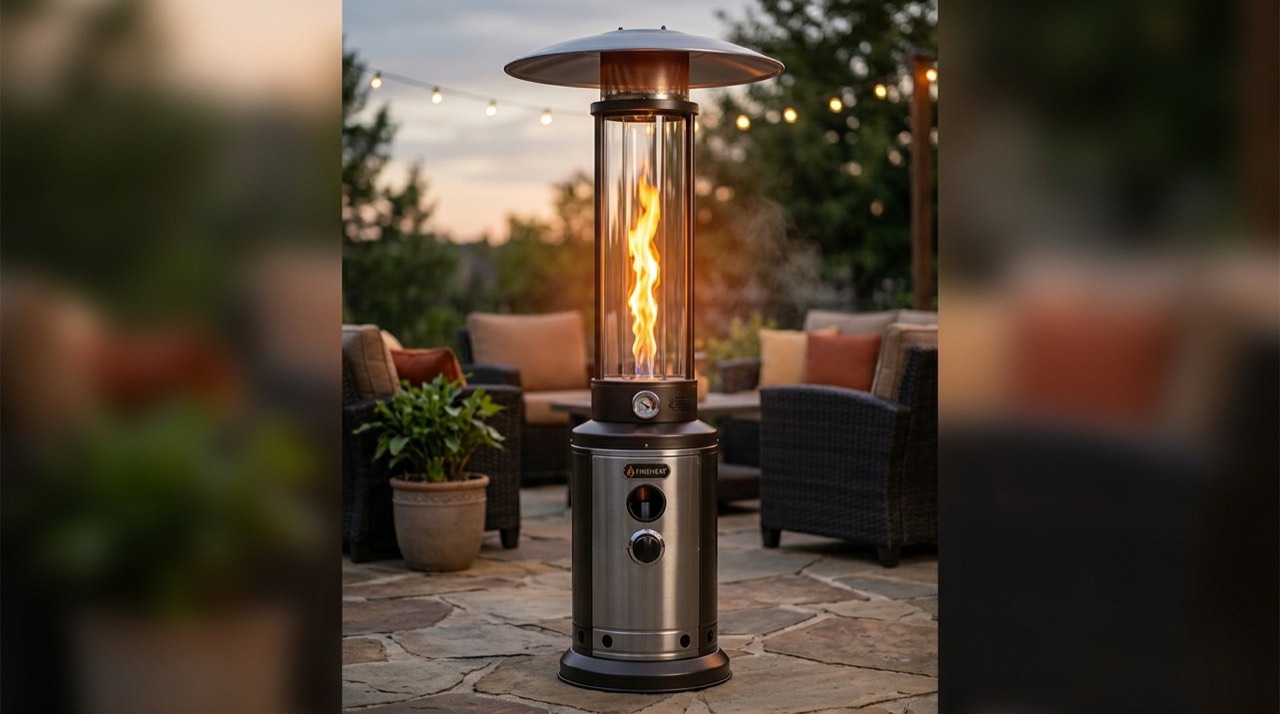
Reading past the star rating on the most-reviewed standing patio heaters turns up a few consistent patterns. Assembly is the single most common complaint across the category. These are multi-piece units shipped disassembled, and owners regularly mention the base, pole and burner head taking longer to put together than expected — sometimes 30–45 minutes on a first attempt. Once assembled, satisfaction tends to track closely with expectations about coverage. Buyers who treat the manufacturer's square-footage estimate as a hard number are more likely to be disappointed than buyers who read it as a best-case figure, achievable only in still air. The other recurring theme is wind sensitivity. Even heaters with a weighted base draw complaints from owners in consistently breezy locations, and a sandbag or additional ballast kit shows up often in reviews as an add-on people wish they'd bought at the same time as the heater.
Stainless Steel vs. Painted Steel Construction
Patio heaters are built from either stainless steel or powder-coated carbon steel, and the difference matters more outdoors than it would on an indoor appliance. Stainless steel resists rust and holds up better to repeated exposure to rain, humidity and temperature swings. That's why it commands a price premium, and why it shows up more often in owner reviews as lasting multiple seasons without visible corrosion. Powder-coated steel is more budget-friendly, and it performs fine if it's covered or stored indoors between uses. But owners who leave a painted-steel heater outdoors year-round in a humid or coastal climate more often report rust starting at seams and screw points within a season or two. If a heater will live outside permanently rather than being stored, stainless steel is the more durable long-term choice even at a higher upfront cost.
Placement, Wind Resistance and Weatherproof Cover: Weighted Base and Sandbag Guidance
Every patio heater manual specifies minimum clearance from combustible materials, overhangs and structures, and that guidance is not just a liability disclaimer — it reflects how far the unit's radiant heat and any flame or exhaust actually reaches. Common manufacturer guidance calls for keeping a standing heater several feet clear of umbrellas, awnings, string lights and any fabric or overhead structure. Sustained heat exposure close to the burner head can scorch or ignite materials that wouldn't be a concern a few extra feet away. Placing a heater on a stable, level, non-flammable surface — not directly on grass, mulch or a wood deck without a heat-resistant pad in some cases — is also standard guidance worth checking against the specific model's manual before first use.
Propane vs. Natural Gas Patio Heaters
Most portable patio heaters run on propane specifically because they need to be movable and self-contained. A propane tank travels with the heater. A natural gas patio heater requires a fixed gas line and professional installation instead, trading portability for the convenience of never swapping a tank. If you're comparing the two, a propane unit is almost always the right choice for a heater you might reposition, take to a different property, or store seasonally; a natural gas heater makes more sense only for a genuinely permanent outdoor kitchen or entertaining area where the plumbing work is already justified by other fixed appliances.
Alternatives Worth Considering: Infrared Heaters and Fire Pits
A standing propane heater isn't the only way to add outdoor warmth. Electric infrared patio heaters are a common alternative where an outlet is already nearby. They skip the tank entirely, but they need continuous power, and they're generally weaker per dollar of running cost than propane in colder conditions. Wood-burning or propane fire pits are another popular choice for ambiance as much as heat, though they cover a smaller radius and, in the case of wood, come with more cleanup and often stricter local burn regulations than a propane heater. For most people prioritizing coverage area and simplicity, a propane standing or tank-top heater remains the most straightforward option, which is part of why it dominates owner review volume in this category.
Multi-Heater and Commercial Patio Heater Setups for Larger Patios
Restaurants and larger residential patios rarely rely on a single heater. The same logic applies at home once a seating area grows past a small bistro table and two chairs. Spacing two or three standing heaters around the perimeter of a larger space consistently outperforms one heater in the center. Radiant heat drops off quickly with distance, and a single central heater creates an uneven hot-and-cold pattern rather than even warmth across the seating area. A commercial patio heater setup for a restaurant follows the same principle at a larger scale: multiple mid-output units spaced around the perimeter, rather than one maximum-BTU heater trying to cover the whole space, giving the flexibility to run fewer heaters on milder evenings.
Buying Checklist: Piezo Igniter, QCC-1 Connector and Other Basics for an Outdoor Propane Heater
- Confirm the coverage area against your actual space — measure the seating or dining area rather than relying on the heater's headline BTU number alone.
- Check for a recognized safety certification like CSA, and confirm the unit includes an automatic tip-over shutoff.
- Decide between stainless and painted steel based on whether the heater will be covered/stored or left outdoors year-round.
- Confirm piezo igniter reliability in owner reviews — it's the standard ignition type across this category and should light on the first or second try in cold weather.
- Check the fitting is a standard QCC-1 connector if you plan to reuse a tank, hose or regulator from another heater.
- Budget for a weatherproof cover if the heater will live outside between uses — it meaningfully extends the life of the burner and reflector.
- Plan for wind if your patio or deck is in a consistently breezy spot — a weighted base or sandbag kit is cheap insurance against tipping.
Storage Between Seasons
A standing patio heater spends most of the year in storage in many climates, and how it's stored matters for how well it performs the next time it's used. Manufacturers recommend disconnecting the tank before storage, covering the unit if it's kept outdoors, and keeping it somewhere dry to prevent the burner assembly and reflector from corroding. A patio heater cover is a low-cost accessory that owners who keep their heater outside year-round consistently mention as worth buying, since it protects against both moisture and dust buildup in the burner. Before the first light of a new season, check the hose, regulator and burner ports for spider nests, debris or cracking. This catches most "won't light after winter storage" problems before they turn into a mid-use failure. Spiders and insects nesting in an unused burner tube over a season of storage is a well-documented cause of ignition problems across gas appliances generally — not something specific to any one brand.


