
Affiliate disclosure: some links are affiliate links — as an Amazon Associate we earn from qualifying purchases, at no extra cost to you. Full disclosure.
A propane patio heater lives or dies on one number most buyers underweight: coverage area. BTU output matters, but two heaters with the same BTU rating can feel completely different depending on their design. We looked at standing, tank-top and tabletop propane heaters across dozens of owner reviews and manufacturer coverage specs, and ranked the six that come up most consistently as reliable, well-reviewed choices. Every ranking below reflects aggregated owner reviews, manufacturer specifications and safety certifications.

How We Picked These Best Overall Propane Patio Heaters
Four factors decided this list. First, coverage area against the manufacturer's own published radius, not just the headline BTU number. Second, safety certification — CSA or a comparable third-party mark, plus tip-over protection and auto shutoff. Third, build material, since stainless steel and painted steel age very differently outdoors. Fourth, what owners report after a full season of actual outdoor exposure, not an unboxing review. A heater with strong specs but a pattern of assembly or wind-stability complaints across dozens of reviews was ranked lower or dropped entirely. Other well-known freestanding heater brands like Hiland, Fire Sense and Bluu build similar commercial-grade standing heaters in this category, though the six picks below have the strongest owner-review track record.
The Short Answer: Mushroom Heater and Pyramid Heater Standouts
For most people asking "what’s the best propane patio heater," the BALI OUTDOORS Stainless Steel Standing Heater is the safest starting point — it covers a genuinely large seating area, and stainless steel holds up outdoors far better than painted steel over multiple seasons. Want the same style with independent CSA safety certification at a lower cost? The Giantex 50,000 BTU Standing Heater is the pick. Working with a small balcony instead of a full patio? Skip standing heaters entirely and go straight to the Cuisinart Tabletop Heater.

Best for A mid-size to large patio or deck that needs real coverage area
- Stainless steel construction resists rust
- Wide dome reflector for even heat throw
- Wheeled base for repositioning
- Piezo ignition, no batteries
Why buy it: It is one of the most-reviewed standing patio heaters on the market, and owners consistently praise the coverage radius and the fact that stainless steel holds up season after season outdoors without the rust that plagues cheaper painted-steel units.

Best for Buyers who want third-party safety certification at a lower price point
- 50,000 BTU output
- CSA certified — independently tested
- Tip-over protection and auto shutoff
- Side shelf and wheeled base
Why buy it: CSA certification is worth paying attention to on any standing patio heater, since it confirms independent safety testing rather than just a manufacturer claim, and owners specifically call this model out as the certified option that does not cost noticeably more than an uncertified equivalent.

Best for Patios and open garage bays where 360° heat throw matters more than height
- 45,000 BTU, screws directly onto a 20 lb tank
- 540° swivel head throws heat almost every direction
- Piezo ignition
- No standing base to assemble
Why buy it: Owners who replaced a standing patio heater with a tank-top unit consistently report comparable warmth in a smaller footprint, and the 360° swivel head suits a patio seating area better than a heater that only throws heat in one direction.

Best for Smaller patios where a full-size tank-top unit is more than needed
- 360° radiant heat pattern
- Compact profile — under 21 inches tall
- Screws directly onto a 20 lb propane tank
- No electricity or batteries required
Why buy it: This is the pick for a smaller patio or deck that would be overwhelmed by a 45,000 BTU tank-top unit — owners specifically mention it as the right size for a two-to-four-chair seating area rather than a full dining patio.
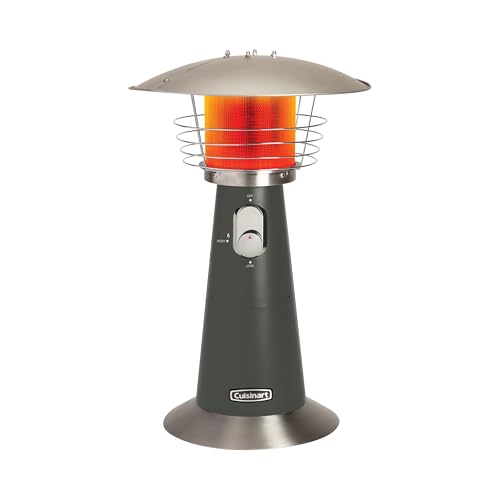
Best for Balconies, small tables and apartment patios with limited floor space
- 11,000 BTU output
- Anti-tilt safety switch
- Sits directly on a table rather than the ground
- Adjustable heat control
Why buy it: A tabletop design solves the floor-space problem a standing heater creates on a small balcony, and owners consistently mention it as the option that actually fits on an apartment-size patio without dominating the space.

Best for Camping-adjacent outdoor use and buyers who want a heater that packs away small
- 9,000 BTU output
- 8 ft hose for tank flexibility
- Self-ignition
- Tip-over and low-oxygen safety shutoff
Why buy it: It trades raw coverage area for genuine portability, and owners moving between a patio, a campsite and a tailgate setup consistently pick this style over a bulkier standing heater for exactly that flexibility.
Full Comparison
All six picks side by side. "Best for" reflects the specific patio size and setup each heater is most consistently recommended for in owner reviews.
| Product | Best for | Buy |
|---|---|---|
| BALI OUTDOORS Propane Patio Heater, Stainless Steel Standing | Best Overall | Check Price |
| Giantex 50,000 BTU Standing Gas Heater with Wheels, CSA Certified | Best CSA-Certified Value | Check Price |
| Mr. Heater Original 540° 45,000 BTU Tank Top Radiant Propane Heater | Best Tank-Top for Wide Coverage | Check Price |
| Dura Heat TT-360 Propane Tank Top Heater | Best Compact Tank-Top | Check Price |
| Cuisinart Patio Heater, Tabletop, 11,000 BTU with Anti-Tilt Safety Switch | Best Tabletop | Check Price |
| Portable Outdoor Heater with 8FT Hose, 9,000 BTU | Best Ultra-Portable | Check Price |
Standing Heater vs. Tank-Top vs. Tabletop Patio Heater vs. Glass Tube Heater (Quartz Glass): Which Style Fits
Three of today's picks are standing heaters, two are tank-top, and one is a tabletop patio heater — and the style matters as much as the BTU rating. A standing heater throws heat from roughly seven feet up, which suits a larger dining or seating area spread around its base. A tank-top heater sits low and throws heat in a 360° radius from a shorter unit, better suited to a tighter cluster of chairs. A tabletop heater solves a different problem entirely: floor space. A glass tube heater is a related but distinct standing design, using a tall quartz glass tube around the flame for visible ambiance alongside the heat, rather than a plain metal pole. If your patio or balcony genuinely doesn't have room for a standing base, a tabletop unit is the only style that makes sense, regardless of how much coverage a bigger heater could theoretically provide. Our standing vs. tabletop guide covers this decision in more depth.
Heat Coverage and Heat Radius: What the BTU Output Number Doesn't Tell You
A 45,000–50,000 BTU output standing heater typically covers somewhere in the 150–200 sq ft range in mild, calm conditions, with that heat radius shrinking meaningfully in wind. A tank-top heater in the same BTU class covers a similar heat coverage area but in a different shape, since the heat radiates from a lower point. Coverage numbers on the box assume close-to-ideal conditions, so treat them as a ceiling rather than a guarantee, especially if your patio sees regular wind. Our patio heater coverage guide breaks this down heater by heater.
Stainless Steel vs. Painted Steel: Why It Matters More Outdoors
Two of today’s top picks are stainless steel, and that’s not a coincidence. A patio heater lives outdoors, exposed to rain, humidity and temperature swings in a way almost no other product on this site does. Painted or powder-coated steel is more budget-friendly upfront, but owners who leave one outside year-round in a humid climate report rust starting at seams and screw points within a season or two. Stainless steel costs more but holds up for multiple seasons without that problem, which is why it tends to earn stronger long-term reviews even though the initial price is higher.
Ignition Type: Piezo Igniter vs. Electronic Ignition
Every heater on this list uses a piezo igniter — a spring-loaded mechanical spark generator that needs no batteries and works reliably in cold weather, exactly when you need a patio heater to light on the first try. Some higher-end standing heaters offer electronic ignition instead, powered by a small battery pack. That can feel more convenient in mild conditions, but it introduces a battery that can die at an inconvenient moment. For a heater that sits outdoors through variable weather, piezo's simplicity is generally the more dependable choice.
Assembly Time, Reflector Dome Attachment and What to Expect Out of the Box
Standing heaters ship disassembled, and this is the single most common source of first-impression frustration in owner reviews, independent of the heater's actual quality. Expect 30–45 minutes for a first build, involving the base, pole, burner head, reflector dome and, on some models, a side shelf. Having a second pair of hands helps more than most instructions suggest, since holding the pole steady while threading the burner head and reflector dome on is awkward solo. Tank-top and tabletop heaters need essentially no assembly.
Safety Certification: CSA Certified and Tip-Over Switch Protection
CSA certification, which the Giantex model carries explicitly, means the heater has been independently tested against a recognized safety standard rather than relying solely on the manufacturer's own claims. It's worth checking for on any standing heater you're considering, alongside basic features like an automatic tip-over switch — which every pick on this list includes, since it's close to a baseline expectation for the category now rather than a premium feature.
What Owners Report About the Less-Obvious Picks
The standing heaters draw predictable praise for coverage and predictable complaints about assembly time — most ship disassembled, and 30–45 minutes for a first build is common. The tank-top picks draw a different pattern: owners specifically mention replacing a standing heater with one and getting comparable warmth in less storage space, with the main complaint being that the piezo igniter sometimes needs a few clicks to catch in windy conditions. The tabletop Cuisinart draws praise almost entirely from apartment and small-balcony owners who simply had no floor space for anything bigger, and the anti-tilt switch gets specific mention as reassuring on an elevated table surface. The ultra-portable hose-connected heater is reviewed by a different crowd entirely — campers and tailgaters who value packing it into a bag over any of the coverage-area considerations that matter to a fixed patio.
Wind Resistance, Sandbag and Placement
Every standing heater on this list needs a weighted base or sandbag kit in a consistently breezy location — even the stainless steel models with a wide base can tip in a strong gust. Tank-top and tabletop heaters sit lower and are inherently less wind-sensitive as a tip-over risk, though wind still cuts their effective coverage radius. If your patio is exposed rather than sheltered, weigh that into the standing-vs-tank-top decision as much as the coverage numbers themselves.


Fuel Setup: 20-lb Propane Tank Size and QCC-1 Connector
All six heaters on this list connect to a standard 20-lb propane tank rather than a smaller disposable cylinder, the practical norm for this output category. Each one uses the same QCC-1 connector fitting, so a tank and hose from one of these heaters works with another. Budget for the tank itself as a separate purchase if you don't already own one, and check that any tank you have passes current OPD-valve requirements — older tanks without one can't legally be refilled at most stations. Our tanks, hoses and accessories guide covers what to check before your first refill.
Buying Checklist: Coverage Area, Weatherproof Cover and Wind
- Match coverage area to your actual seating space, not the heater's headline BTU number.
- Choose stainless steel if the heater lives outside year-round; painted steel is fine if it's covered or stored between uses.
- Check for CSA or comparable third-party certification plus an automatic tip-over shutoff.
- Plan for wind if your patio is exposed — a weighted base is cheap insurance against tipping.
- Buy a weatherproof cover if the heater will live outside between uses.
- Consider tank-top or tabletop if floor space is tight rather than defaulting to a standing heater.
- Budget for a 20-lb tank separately if you don't already own one that meets current OPD-valve refill requirements.
Cost Per Hour of Actual Use and Run Time
Because every pick on this list runs at a different BTU output, the real cost of running one for an evening varies across the six, independent of purchase price. A 50,000 BTU standing heater burns through fuel faster than the 11,000 BTU tabletop pick, which matters if you run the heater for hours most evenings through a whole season. Factor run time and expected usage frequency into the decision alongside coverage area — the heater that looks like the better value on the shelf isn't always the cheaper one to operate over a full season. An adjustable output setting lets you run lower on mild evenings and save full output for cold nights, which stretches a single tank further.
Warranty and What It Covers
Most propane patio heaters carry a limited manufacturer warranty covering defects in materials and workmanship for a year or more, but that coverage typically excludes rust or corrosion from outdoor exposure — precisely the failure mode painted-steel heaters are most prone to. Keep the receipt and register the product where the manufacturer offers it, since warranty claims on outdoor gas appliances move faster with a purchase date on hand. Photograph the heater's condition and model/serial sticker at purchase too. It costs nothing and saves a scramble if a claim ever needs it.