
Affiliate disclosure: some links are affiliate links — as an Amazon Associate we earn from qualifying purchases, at no extra cost to you. Full disclosure.
A forced-air propane heater uses a fan to blow heated air across a space, rather than warming people and objects directly the way a radiant heater does. That single design difference is why forced-air units dominate garage, workshop and construction-site heating: they're built to raise the ambient temperature of a large, enclosed, often uninsulated space, which a radiant heater isn't designed to do efficiently. If you searched for a portable propane heater forced air option specifically, it's almost always because a room or space — not a person sitting in one spot — needs to actually warm up.
Top 3 Recommended
How a Portable Propane Heater Forced Air Unit Works
Inside a forced-air heater, a burner heats air that a fan then pushes out across the room, often 30 to 50 feet or more depending on the model. That moving column of heated air is what raises the ambient temperature of the whole space over time, rather than warming just what's directly in front of the heater. Most forced-air construction heaters use continuous electronic ignition rather than a standing pilot light, and they're rated at much higher BTU output than a portable radiant heater — commonly 50,000 to 150,000+ BTU — because they're designed to overcome the heat loss of a large, often poorly insulated garage, warehouse or job site.
Forced Air Propane Heater Basics: Torpedo Heater, Propane Torpedo and Job Site Heater Output Range
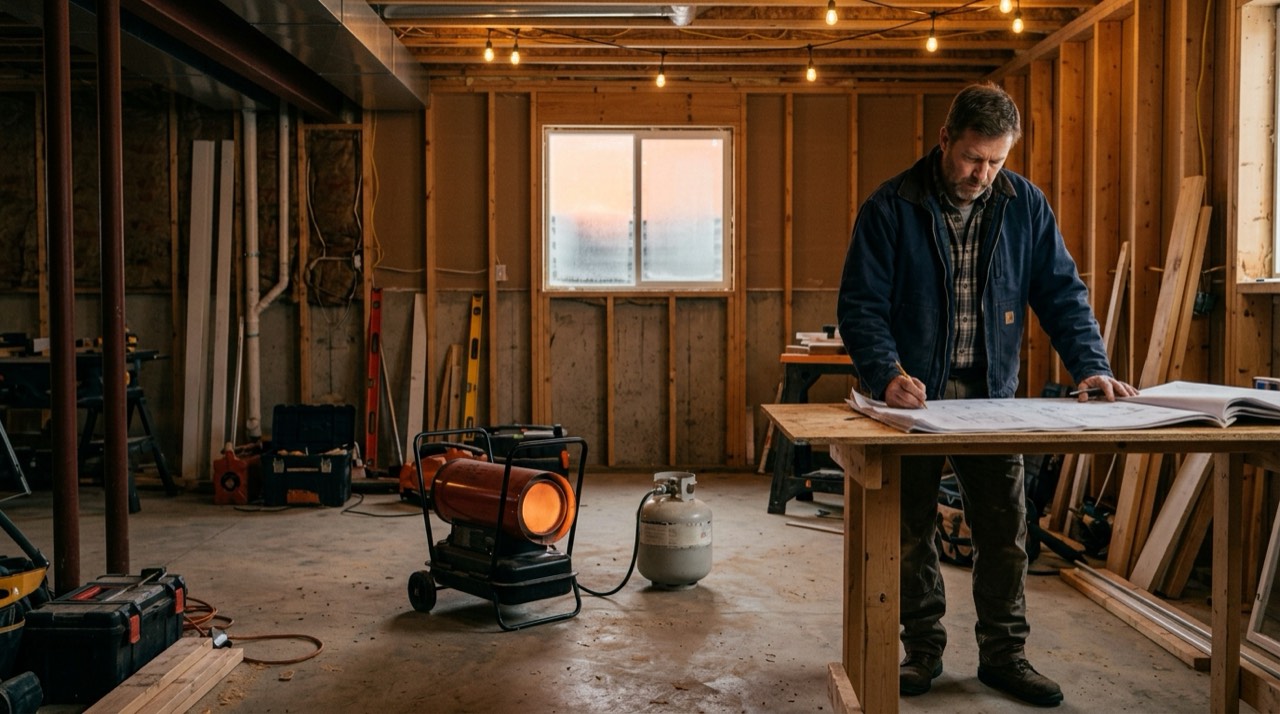
A forced air propane heater is also called a torpedo heater or propane torpedo on a job site, named for its cylindrical burner housing.
Output Range: Variable Heat and a Hose and Regulator Included
As a job site heater, output range varies enormously — smaller units run at a fixed setting while larger models offer variable heat via a dial, and most ship with a hose and regulator included rather than sold separately.
Continuous Ignition, Blower Fan and Thermostat Control
Every unit in this category uses continuous ignition (electronic, not a standing pilot) paired with a blower fan strong enough to throw heated air 30 to 50 feet or more. Unlike a wall-mount heater, none of these units include a thermostat control — output is set manually.
Fuel Consumption in GPH Fuel Usage and 20-lb Propane Tank Run Time
Fuel consumption is sometimes quoted in GPH fuel usage rather than a flat BTU figure, useful for estimating how long a 20-lb propane tank actually lasts before a swap.
Forced-Air vs. Radiant: Why Garages Need a Different Heater
A two-car garage with a high ceiling, an uninsulated door and cold concrete floor loses heat fast, and no amount of radiant heat aimed at one spot changes the ambient temperature of the whole space. A forced-air heater is built for exactly this scenario: it moves enough heated air fast enough to actually raise the room's temperature over time, where a radiant heater would only ever warm what's directly in its path. The tradeoff is that forced-air heaters are outdoor-use-only in almost every case — they lack the oxygen depletion sensor that makes a radiant Buddy-style heater indoor-safe, and they need active ventilation to operate. See our radiant heater guide for the opposite end of this comparison.
Sizing a Forced Air Heater for a Garage or Workshop
The DEWALT 68,000 BTU Forced Air Propane Heater, rated for roughly 1,700 square feet, is a common choice for a single large garage bay or a mid-size workshop. Stepping up to the Mr. Heater 125,000 BTU Forced Air Propane Heater or the Dyna-Glo RMC-FA150DGD 120,000–150,000 BTU Forced Air Heater makes sense for a larger uninsulated space — a two-car garage used as a workshop, a barn, or an active construction area. As a rough starting point, uninsulated spaces typically need well above the 20–30 BTU-per-square-foot guidance used for a sealed, insulated room; a poorly insulated garage can realistically need 40+ BTU per square foot to reach and hold a comfortable working temperature. Our BTU sizing guide covers this calculation in more depth.
Ventilation Requirements Are Not Optional
Every forced-air propane heater on the market is rated outdoor-use-only or "well-ventilated area only" for a specific reason: without an oxygen depletion sensor, these heaters can produce carbon monoxide in a sealed space without any automatic safety shutoff. Manufacturer manuals specify active ventilation requirements — typically a certain amount of fresh air exchange per hour — that must be met before running the heater, even in a garage with the door partially open. This isn't a suggestion; it's the difference between safe operation and a genuine carbon monoxide hazard. Our indoor safety guide covers the broader carbon monoxide picture, and it applies with extra weight to forced-air heaters specifically.
Forced-air heaters for job sites and garages are generally built to the ANSI Z21 family of gas-heater safety standards. OSHA sets workplace exposure limits for carbon monoxide on job sites running fuel-burning equipment like these. The CPSC also publishes seasonal safety warnings on CO poisoning from portable heaters used in garages and enclosed work areas. A minority of forced-air models add a tip-over shutoff too. It's less universal here than on indoor-safe radiant heaters, so check the specific model's spec sheet rather than assuming.
Noise Levels: The Tradeoff Nobody Mentions Upfront
Forced-air heaters run a combustion fan continuously, and owners consistently describe the noise level as comparable to a shop vacuum or small generator — loud enough that hearing protection is a reasonable consideration during extended use in an enclosed garage. This is a real tradeoff against the near-silent operation of a radiant or catalytic heater, and it's worth factoring into the buying decision if the space will be occupied for hours at a time rather than heated briefly before work begins. Some job-site crews run the heater to bring a space up to temperature before starting work, then reduce or cycle it, partly to manage the noise as much as the fuel use.
Cordless vs. Corded Forced-Air Heaters
Most forced-air propane heaters need electricity to run their ignition system and fan, which means a corded unit needs a nearby outlet or generator — a real constraint on a job site without power yet. Some models offer a cordless, battery-powered ignition option specifically to solve this, trading a longer battery-management routine for independence from a power source. If a job site or garage doesn't have reliable power, checking whether a specific forced-air heater needs a continuous electrical connection or just battery-powered ignition is worth doing before buying, since it changes what else you need to bring to the site.
Fuel Consumption and Running Cost at High BTU Output
Forced-air heaters burn through propane fast compared with a radiant or catalytic heater, simply because they're rated so much higher. Using the standard conversion of roughly 21,600 BTU per pound of propane, a 125,000 BTU forced-air heater running at full output burns through a standard 20 lb propane tank in a little over 3 hours. Job sites and workshops running a forced-air heater regularly typically connect to a 100 lb propane tank or larger rather than a standard 20 lb grill tank, both for the extended run time and to avoid constant tank swaps during a work day. Some crews go a step further and plug into a large fixed propane tank already on site for other equipment, which removes tank-swapping from the job entirely. Our tanks and accessories guide covers tank sizing for higher-output heaters.
Job Site Safety Checklist: Fire Hazards Near a High-Output Heater
- Confirm ventilation before starting the heater — an open garage door or job-site airflow needs to meet the manual's stated minimum, not just "feel" ventilated.
- Keep the heater clear of combustible materials and dust — construction sites accumulate sawdust and debris that can be a fire hazard near an open-flame or high-output heater.
- Never leave a forced-air heater running unattended overnight — these are not rated for the kind of continuous, unattended operation an indoor-safe radiant heater might be.
- Plan for tank capacity at the actual BTU rating — a 20 lb tank empties fast on a 100,000+ BTU heater; budget for a larger tank or more frequent swaps.
Garage Heating and Workshop Heating: Other Brands to Know
For garage heating and workshop heating specifically, sizing against the 40+ BTU-per-square-foot guidance above still applies regardless of brand. Beyond Dyna-Glo, Mr. Heater and DEWALT, Bauer and Craftsman also sell comparable forced-air units worth cross-shopping if your usual supplier carries one of those brands.
Overheat Shut-Off and CSA Certified: What Separates a Tested Heater From an Import
Look for a model that pairs continuous electronic ignition with an overheat shut-off, and confirm it's CSA certified — that certification, alongside NFPA 58's rules for LP-gas cylinder storage and handling on a job site, is what separates a properly tested heater from an uncertified import.
Cordless Forced Air Options for a Site Without Power
A cordless forced air option with battery-powered ignition is worth the extra cost on a site without power yet, even though it adds a battery-management routine most corded units don't need.
Dyna-Glo vs. Mr. Heater vs. DEWALT: How the Brands Compare
All three major forced-air brands build the same basic product — a burner, a fan, a fuel line and a cage or cart frame — but owner reviews consistently point to a few differences worth knowing before buying. Dyna-Glo's RMC line is frequently praised for its adjustable BTU range, letting a single heater scale from a moderate setting up to its full 150,000 BTU rating rather than running at one fixed output. Mr. Heater's forced-air construction line draws on the same brand reputation for reliability that built the Buddy series, and owners who already trust the brand for radiant heaters often stick with it for forced-air units too. DEWALT's entry into the category leans on the brand's job-site tool ecosystem — some models share battery platforms with DEWALT power tools, which contractors already invested in that ecosystem specifically mention as a practical advantage over carrying a separate charger or battery type just for the heater.
Electronic Ignition vs. Standing Pilot
Nearly all modern forced-air construction heaters use continuous electronic ignition rather than a standing pilot, which saves fuel when the heater is off and resists blowing out in windy job-site conditions. That ignition system needs a power source, which is why nearly every unit must be plugged in or run on battery power rather than being fully self-contained the way a radiant Buddy heater is — more heat output and more reliable ignition, in exchange for needing an electrical connection alongside the propane supply.
Common Problems and What They Usually Mean
A forced-air heater that won't ignite is, in the large majority of owner-reported cases, either a power supply issue with the ignition system, a low or empty tank, or a fuel line that hasn't been purged of air after a tank change. A heater that ignites but shuts off shortly after is often tripping a safety sensor due to insufficient airflow or ventilation — which, as covered above, is a real safety signal rather than a nuisance to bypass. A heater that runs but produces noticeably less heat than expected is frequently a sign of a partially clogged nozzle or a regulator issue rather than a fan or burner failure. Our troubleshooting and repair guide walks through diagnosing each of these symptoms in more detail.
Maintenance Between Job Site Seasons
Forced-air heaters see harder use than a residential radiant heater — more dust, more debris, more moves between job sites — and owners who get multiple seasons out of one consistently mention basic maintenance as the reason. Cleaning dust from the fan intake and burner assembly, checking the fuel line for wear each new season, and storing the heater dry between uses all show up repeatedly as the difference between a heater that lasts years and one that fails prematurely. Because these units run hot for extended periods, dust buildup on internal components is also a legitimate fire-risk consideration, not just a performance issue.
Buying New vs. Used for Construction Heaters
Forced-air heaters see enough job-site wear-and-tear that buying used carries more risk than it would for a simple radiant heater. The fan motor, ignition system and fuel regulator all degrade with heavy use, and a used unit's history is harder to verify. For a heater running unattended at high output in a work environment, the safety margin of a new unit with a full manufacturer warranty is generally worth the extra cost over a secondhand model of unknown history.
What Contractors and Owners Report
Across owner and contractor reviews, the Dyna-Glo and Mr. Heater forced-air lines both draw consistent praise for how quickly they raise the temperature in a genuinely cold, large space — multiple reviewers describe bringing a cold garage to a workable temperature in well under 30 minutes. The most common complaints are noise, as covered above, and the physical bulk and weight of the higher-BTU models, which are meaningfully less portable than a Buddy-class radiant heater and are generally moved on a cart or dolly rather than carried by hand.


