
Affiliate disclosure: some links are affiliate links — as an Amazon Associate we earn from qualifying purchases, at no extra cost to you. Full disclosure.
"Best propane heater for patio" depends entirely on the patio. A tabletop heater that’s perfect for a two-chair balcony would look absurd, and heat almost nothing, on a large dining patio built for eight. Rather than one flat ranking, this guide matches a propane patio heater to the specific space and situation people searching this term usually have. For a straight ranked top-6 list instead, see our best propane patio heater roundup. Every recommendation reflects aggregated owner reviews and manufacturer coverage specs.
Start With Square Feet, Not BTU
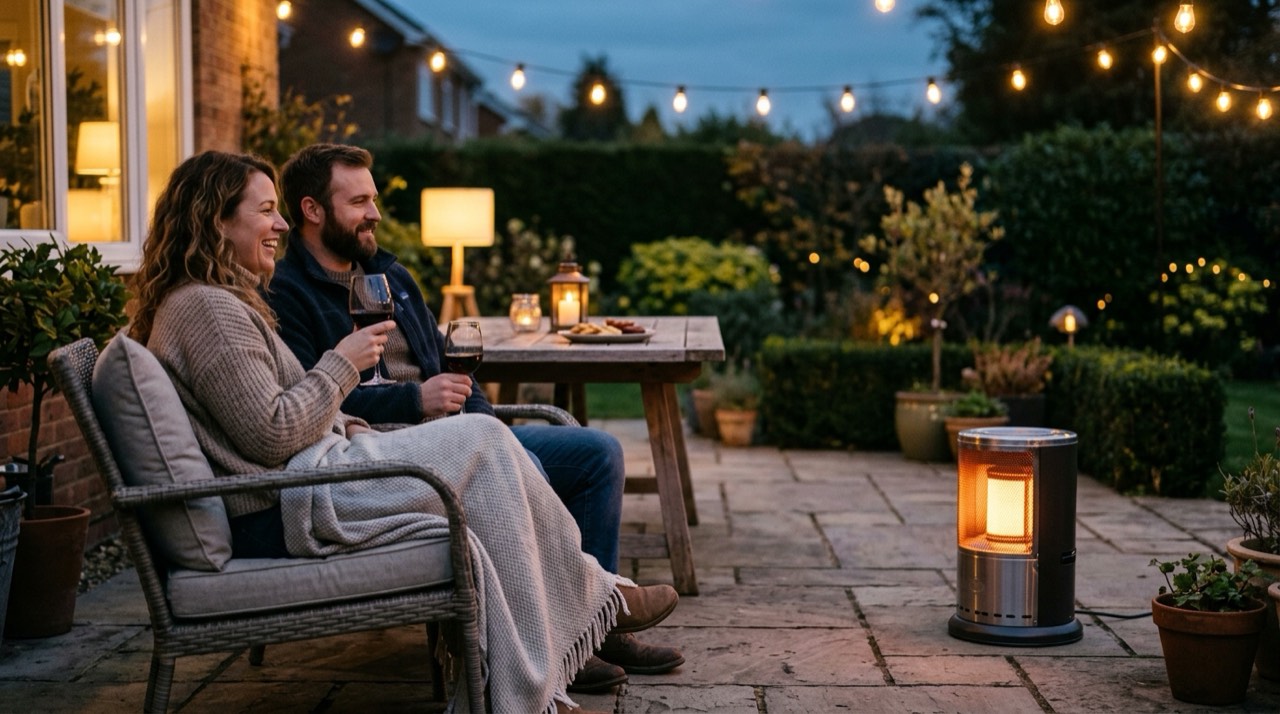
Before picking a scenario below, measure your actual patio or seating area in square feet. That single number narrows the field faster than comparing BTU ratings side by side, because coverage area — how far usable heat actually reaches — matters more than the number printed on the box. A heater rated for 200 sq ft in a manufacturer’s ideal conditions often covers less in a real, breezy backyard.
Mushroom Heater vs. Pyramid Heater vs. Standing Heater: Shape and Heat Coverage
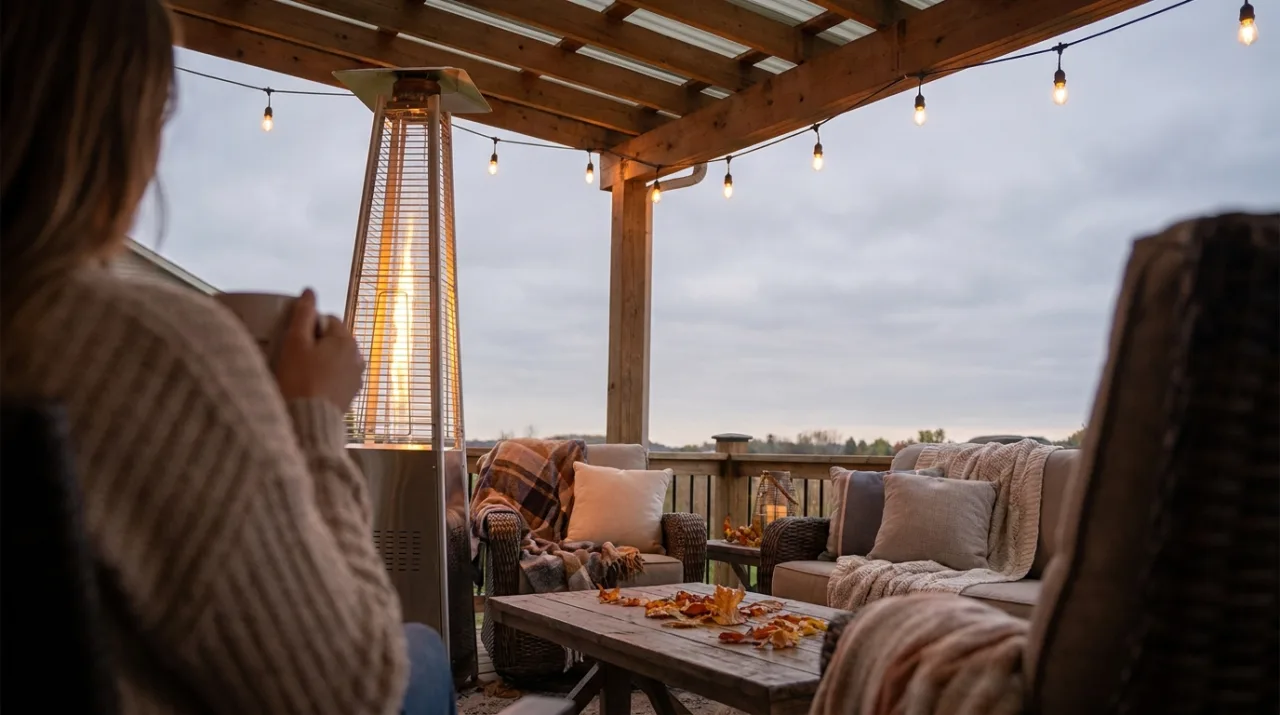
Standing propane patio heaters come in a few recognizable shapes, and the shape affects how heat actually spreads. A mushroom heater has a wide dome reflector on top that throws heat down and outward in a broad circle, which is the shape most people picture when they think "patio heater." A pyramid heater uses a tapered glass-tube column instead, running visible flame up the middle for more ambiance alongside the heat. Both are freestanding heater designs that stand on their own base rather than mounting to a tank or a table. Brands like Hiland, Fire Sense and Bluu all build mushroom- and pyramid-style standing heaters in this same category, alongside the picks below.
For a Small Balcony: Best Tabletop Heater Pick
A small apartment balcony or a compact two-chair patio has one hard constraint a standing heater can't solve: floor space. The Cuisinart 11,000 BTU Tabletop Heater sits directly on a table rather than the ground. That's the only practical way to add propane heat to a space this size. Owners in this exact situation consistently recommend it over squeezing a standing heater into a spot it wasn't built for. Its anti-tilt safety switch matters more here than on a ground-based heater, since a table surface is less stable than solid ground.
For a Large Dining Patio: Freestanding Heater and Heat Coverage Radius
A patio built around a full outdoor dining table, or a backyard entertaining space for six or more people, needs real coverage area. That argues for a full-size freestanding heater at 45,000–50,000 BTU, since a wider heat coverage radius matters more than a compact footprint here. The Giantex 50,000 BTU Standing Heater is the pick most owners in this situation land on. Its CSA certification is worth the modest premium over an uncertified equivalent when the heater runs unattended near a group of people for hours at a stretch. For a genuinely large space, don't assume one heater covers everything — see the commercial section below.
For a Windy Exposed Patio: Wind Stability and Weather Resistant Builds
Wind is the factor most patio heater buyers underweight until they own one. A heater rated for 200 sq ft in calm conditions can lose a third of its effective radius in a steady breeze. A lightweight standing heater on a small base can tip in a strong gust, so wind stability depends on base weight as much as height. The BALI OUTDOORS Stainless Steel Standing Heater is the pick most consistently recommended for an exposed location, thanks to its wider base and weather resistant build — though even this model benefits from an added sandbag or weight kit if your patio sees regular wind. If your space is exposed on most sides, a tank-top heater sitting lower to the ground is inherently more wind-stable than a tall standing unit, at the cost of a different heat-throw pattern.
For a Commercial Patio Heater or Multi-Heater Restaurant-Style Setup
Restaurants and larger residential entertaining spaces rarely rely on one heater. The same logic scales down to a large home patio: spacing two or three mid-output heaters around the perimeter consistently outperforms one maximum-BTU unit in the center, because radiant heat drops off quickly with distance and a single central heater creates uneven hot-and-cold zones. For this setup, two Mr. Heater 45,000 BTU Tank Top Heaters positioned at opposite ends of the seating area, or a mix of tank-top and standing units, generally beats one oversized heater trying to do the whole job.
For a Covered Patio or Porch Overhang: Heat Output and Clearance
A covered patio changes the clearance math compared to a fully open backyard, since a standing heater’s rising heat has less room to dissipate before reaching a ceiling or overhang. If your patio has a roof or a large umbrella you don’t want to remove, check the specific heater’s minimum overhead clearance before assuming a standing unit will fit safely under it — several feet of headroom above the heater’s tallest point is typical manufacturer guidance. A lower-profile tank-top heater, which throws heat outward rather than upward toward a ceiling, is often the more practical choice for a genuinely low-clearance covered space. See our safe distance guide for the specific numbers.
For a Rental Patio You Don’t Fully Control
Renters and anyone on a shared balcony or apartment patio face a constraint the other scenarios don’t: limited or no ability to modify the space, plus lease terms that may restrict outdoor propane appliances outright. Before buying anything, check your lease and building rules specifically, since some buildings prohibit propane heaters on balconies regardless of size or safety features. If propane heat is allowed, a tabletop or compact tank-top unit is generally the better fit for a rental anyway, since it requires no permanent placement and travels with you at lease-end the way a bulkier standing heater wouldn’t as easily.
For a Patio That Doubles as a Cooking or Outdoor Entertaining Space
A patio that also hosts a grill, an outdoor kitchen setup, or string lights and other electrical fixtures needs extra attention to clearance and placement beyond the basic coverage question. Keep a patio heater well clear of a grill’s own heat and flame path, and never position one where its clearance zone overlaps with an extension cord or outdoor electrical fixture. This is less about the heater itself malfunctioning and more about not stacking two separate heat or fire sources close enough together that a problem with one compounds the other.
For a Tight Budget: Tank-Top Heater for Occasional Use
Not everyone needs a premium stainless-steel standing heater. If patio heating is occasional rather than a regular fixture, a compact tank-top unit like the Dura Heat TT-360 covers a smaller seating area at a lower cost and stores away easily between uses, without the assembly and storage footprint of a full standing heater.
For a Vacation Home or Seasonal Property: Cover Included and Run Time Matter
A property you visit only occasionally has different priorities than a primary residence. The heater needs to survive months of unattended storage without extensive prep work each time you arrive. A simpler tank-top or compact standing heater with fewer moving parts tends to hold up better through long idle stretches than a feature-rich electronic-ignition model, since there's less that can fail silently while nobody's checking on it. A heater with a cover included is worth the small extra cost here, and checking a model's rated run time per tank before you buy avoids a mid-visit refill run. Disconnecting the tank between visits and giving the burner a quick visual check on arrival covers most of what a seasonal property needs.
Standing Heater on a Wheeled Base or Tank-Top to Match Existing Patio Furniture
Some buyers are less constrained by space or budget than by wanting a heater that doesn’t clash visually with an existing outdoor furniture set. Stainless steel standing heaters read as more modern and tend to pair well with contemporary furniture, while a compact tank-top unit is visually unobtrusive enough to fit almost any style since it doesn’t dominate the space the way a tall standing heater does. This is a legitimate factor in the decision even though it doesn’t show up in a spec sheet, and it’s worth weighing alongside coverage and budget rather than treating heater choice as a purely functional decision.
For a Patio Shared With Pets
A patio heater running near an outdoor pet area introduces a consideration most buying guides skip. Curious pets can knock into a lightweight standing heater or get closer to a hot reflector dome than is safe. A tank-top or tabletop heater within a pet's reach carries similar risk from a lower, more accessible height. If pets regularly share the space, position the heater where they can't easily reach or bump it, and never leave a running heater unsupervised with pets loose nearby. A heater with a wide, stable base and a working tip-over shut-off is the safer choice here, since it's less likely to get knocked over in the first place.
Tip-Over Shut-Off, Stainless Steel and Other Safety Basics
Across every scenario above, a few safety and build-quality basics matter regardless of shape or size. A tip-over shut-off that actually cuts gas flow when the heater falls is close to a baseline expectation now, not a premium feature — confirm it's present rather than assuming. Stainless steel construction costs more upfront than painted steel, but it resists the rust that painted seams develop after a season or two left outdoors. Between the two, stainless steel is the better long-term pick for any heater that lives outside year-round rather than in a garage between uses.
Coverage Area, 20-lb Tank Fuel and Overhead Clearance: What Every Scenario Shares
Regardless of your specific patio, a few things don't change. Coverage area, not BTU alone, decides how many heaters or what size you actually need — see our coverage guide. Nearly every heater in this output range runs off a 20-lb tank connected through a QCC-1 fitting, not a small disposable cylinder. Clearance from the house, umbrellas and overhead structures is non-negotiable regardless of heater style — see our safe distance guide. And every heater benefits from proper off-season storage — see our winter storage guide.

Matching Piezo Ignition Type to How You’ll Actually Use It
Piezo ignition — the standard mechanical spark mechanism across most of this category — needs no batteries and works reliably in cold weather, which matters most for a heater used through a genuinely cold season rather than a handful of mild evenings. Some higher-end standing heaters offer battery-powered electronic ignition instead, which some owners find more convenient but which introduces a battery that can die at an inconvenient moment. For a heater kept at a vacation property or used infrequently, piezo’s lack of a battery to maintain is a genuine practical advantage over electronic ignition’s marginal convenience gain.
Best Value and Outdoor Patio Heater Picks: When None of These Scenarios Quite Fit
If your space is a screened porch or three-season room rather than a fully open patio, the ventilation and heater-certification picture changes — see our porch and screened-space heater guide instead. If you want a flat ranked comparison of the best outdoor patio heater options rather than a scenario match, our ranked patio heater list is the more direct, best value route. And if none of the scenarios above match your situation, two questions matter most: how many square feet do you actually need to heat, and how often will the heater realistically run.