
Affiliate disclosure: some links are affiliate links — as an Amazon Associate we earn from qualifying purchases, at no extra cost to you. Full disclosure.
Not every propane hose is built for the same job. Here’s how the main options compare, sorted by the setup they actually fit best.
Quick Comparison
| Product | Best for | Buy |
|---|---|---|
| 12FT Propane Regulator Hose with Gauge, QCC1 | Best Overall | Check Price |
| Camco Olympian 5-Foot RV Propane Supply Hose | Best for RVs | Check Price |
| GASPRO 12 FT Propane Extension Hose for 100lb Tank | Best for Bulk Tanks | Check Price |
| Dyna-Glo 5' Propane Hose Assembly | Most Compact | Check Price |
Best Overall: A Hose With a Built-In Gauge
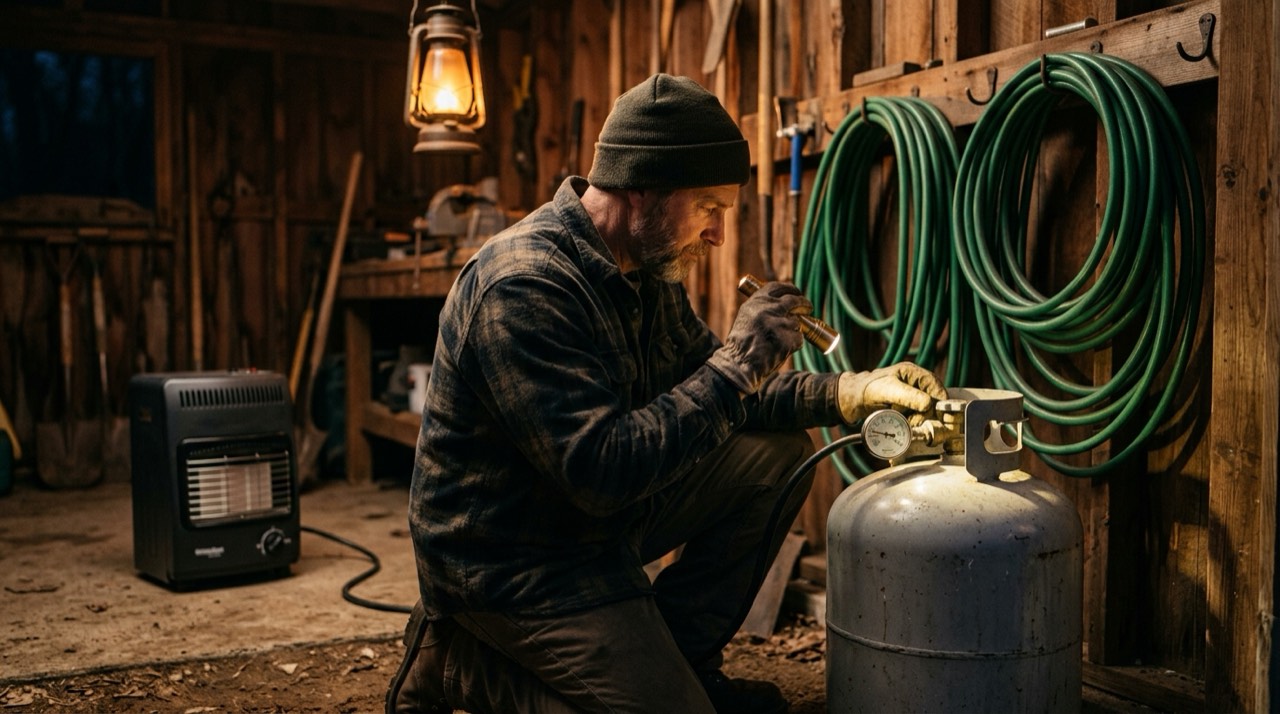
For most portable radiant heaters connecting to a standard 20 lb tank, a braided hose with a built-in pressure gauge is the easiest all-around pick. It fits the common QCC1 tank fitting, and the gauge gives you a fuel-level read that disposable cylinders and plain hoses don’t offer.
Best for RVs: A Purpose-Built RV Hose
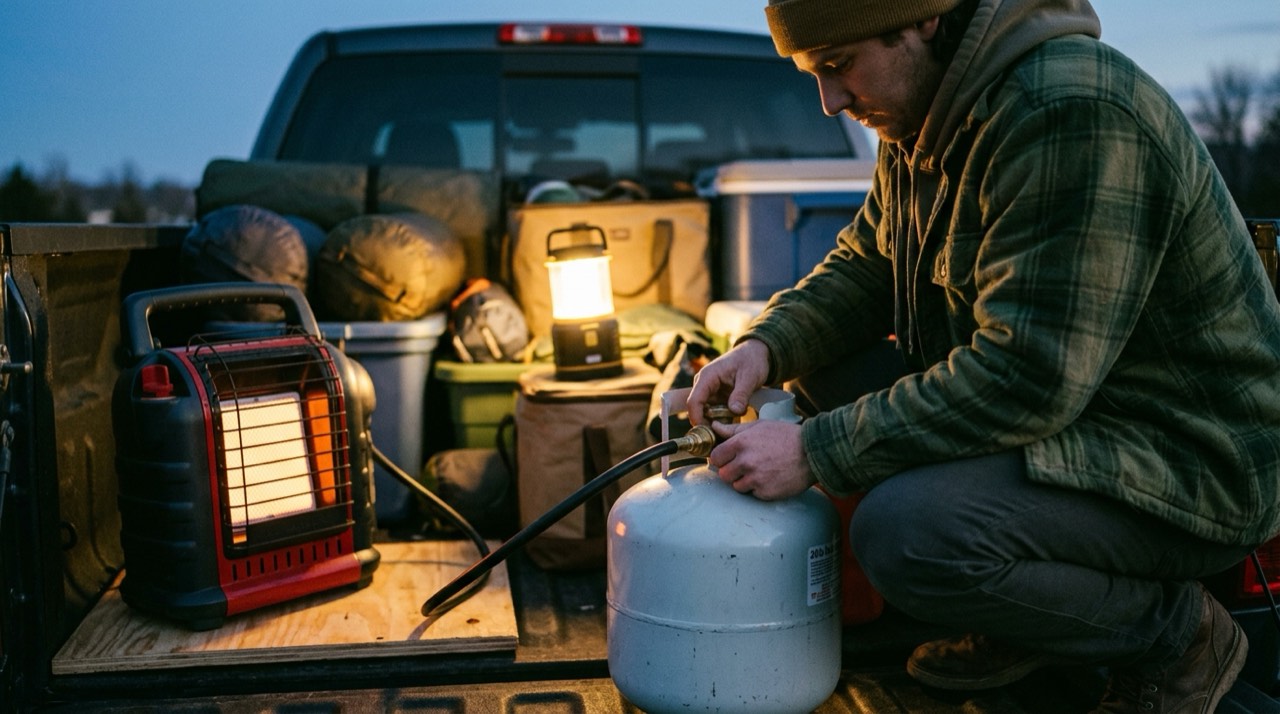
RV propane systems sometimes use different fitting requirements than a standard grill-tank setup. A hose designed specifically for RV catalytic heaters, like a Camco Olympian model, includes built-in excess-flow protection as a safety feature and is designed to connect a motorhome’s onboard tank or a portable tank correctly the first time.
Best for Bulk Tanks: A Longer Extension Hose
Connecting a portable heater to a 100 lb or larger bulk tank calls for a longer hose, since bulk tanks are typically positioned further from where the heater actually runs. A 12 ft extension hose with a POL-to-QCC1 adapter built in handles both the distance and the older fitting type larger tanks commonly use. See our bulk tank connection guide for the full setup.
Most Compact: A Short, Simple Hose
If your tank sits close to the heater and you don’t need a gauge, a shorter, simpler hose assembly is easier to store and less to coil up between uses. This is a reasonable choice for a garage or workshop setup where the tank stays in one spot all season.
Don’t Forget a Filter
Any hose connecting to a refillable tank benefits from an inline fuel filter, which catches debris that a sealed disposable cylinder never exposes a heater to. See our hose and adapter guide for why the filter matters specifically for the Buddy lineup.

Look for a UL 21 Listing
UL 21 is the recognized safety standard for LP-gas hose in the US, covering hose rated for a maximum working pressure of 350 psig across a wide temperature range. A hose carrying this listing has been independently tested for that pressure and temperature performance, rather than simply repurposed from a generic rubber hose that happens to be the right diameter. Check the hose or its packaging for this listing before buying, especially for a hose that will spend a season connected outdoors.
Braided Stainless vs. Standard Rubber Hose
Most hoses in this category use either a braided stainless outer layer over a rubber inner hose, or a plain rubber construction throughout. Braided stainless resists abrasion and UV damage better over time, which matters for a hose that spends a season coiled up outdoors or dragged across a garage floor repeatedly. Plain rubber hoses are usually a bit cheaper and perfectly functional for a hose stored indoors between uses, just with a shorter expected service life if left exposed to the elements.
How Long Should a Propane Hose Last?
A quality propane hose, inspected and stored properly, commonly lasts several years of regular seasonal use before needing replacement. UV exposure and temperature swings are the main things that degrade a hose over time, which is why storing it coiled somewhere protected between seasons, rather than leaving it connected and exposed outdoors year-round, meaningfully extends its working life. Inspect for cracking or stiffness at the start of each season regardless of the hose’s age, since a hose that looks fine at a glance can still have developed a weak spot.
Checking Fit Before You Buy
Confirm your tank’s fitting type (QCC1 or POL) and your heater’s specific hose-connect compatibility before ordering any hose. Not every portable heater supports a hose-connect setup at all — the Little Buddy, for example, is 1 lb-cylinder only. See our tanks, hoses and accessories guide for the fitting types explained in more depth.
Hose Diameter and Flow Rate
Most consumer propane hoses use a standard internal diameter. That works fine across typical portable heater BTU ranges. Very high-output forced-air heaters sometimes need a wider hose instead, to avoid restricting flow at their higher fuel demand. Check your heater’s manual for any specific diameter requirement. Don’t assume a standard hose covers every BTU tier, particularly anything above roughly 60,000 BTU.
Thread Types Explained: QCC1 vs. POL vs. 1"-20
Three different fitting standards show up across this category, and knowing which one your setup uses prevents the single most common ordering mistake. QCC1 (sometimes called Type 1 or the ACME connection) is the wide, hand-tight plastic collar standard on nearly every 20 lb tank sold since the early 2000s, built around the OPD overfill-prevention valve. POL is the older, smaller brass fitting that needs a wrench rather than hand-tightening, and it still shows up on older cylinders and many bulk tanks above 40 lb. The 1"-20 thread, sometimes listed as a CGA-600 connection, is the built-in male thread on a disposable 1 lb cylinder itself, not something you connect with a separate hose fitting in the same way. Confirm which one your tank or cylinder actually has before ordering a hose, since a QCC1-only hose simply won’t thread onto a POL fitting.
Step-by-Step: Connecting and Leak-Testing a New Hose
Start with the heater and tank both fully disconnected from any fuel flow. Thread the hose’s tank-end fitting onto the tank by hand until it stops turning easily, then confirm it’s seated — QCC1 fittings are hand-tight only and shouldn’t need a wrench. Connect the heater-end fitting the same way, following your heater’s manual for any model-specific torque guidance. Before lighting anything, mix a small amount of dish soap with water, open the tank valve slightly, and brush the solution over every fitting on the new hose. Growing bubbles at any point mean a leak — stop, tighten that fitting, and retest before proceeding. Only light the heater once every connection passes a dry, bubble-free check.
When to Replace Instead of Repair
A propane hose isn’t a repairable part. A cracked, kinked, or leaking hose gets replaced outright, not patched. The cost of a new hose is low. Attempting a repair with tape or a clamp introduces real risk for very little savings. If a hose fails a soapy-water leak test anywhere along its length, replace it before the next use. Don’t try to isolate and fix the specific spot.
A Note on Buying Multiples
If you run more than one heater regularly, or split time between a fixed setup and a portable one, keeping a spare hose on hand is cheap insurance against a mid-season failure. A hose is one of the few propane accessories with essentially no downside to having a backup, since it doesn’t degrade meaningfully in storage the way a battery-based product might.
The Bottom Line
Match the hose to the job, not just the tank fitting. A gauge-equipped hose covers most standard portable heaters. An RV-rated hose handles the fitting quirks of RV propane systems. A longer extension hose handles a bulk tank positioned further away. Getting this right the first time avoids a second order and a wasted first attempt, and every option above is inexpensive enough that the real cost of guessing wrong is the delay, not the money.