
Affiliate disclosure: some links are affiliate links — as an Amazon Associate we earn from qualifying purchases, at no extra cost to you. Full disclosure.
The Big Buddy is the highest-output model in the Mr. Heater Buddy lineup, topping out at 18,000 BTU. Here is what that number means in practice, across its three settings, and what room size and run time to expect at each.
Top 3 Recommended
Three Settings, Not One Number
The Big Buddy runs at 4,000, 9,000 or 18,000 BTU, selectable with a dial. That range matters more than the headline 18,000 figure alone. A mild evening in a mid-size garage might only need the 4,000 or 9,000 setting. Full 18,000 output is for genuinely cold conditions or a larger, drafty space. Running on the lowest setting that keeps you comfortable is the simplest way to stretch a tank further.
Room Size by Setting
- 4,000 BTU (low): comfortable for a small room or tent, similar to a standard Buddy on its high setting.
- 9,000 BTU (medium): covers a mid-size room, single-car garage bay, or larger tent.
- 18,000 BTU (high): the Big Buddy’s full range, up to roughly 450 sq ft in reasonably insulated conditions, for a larger garage, wall tent or open basement space.
These figures assume a roughly 20–30 BTU-per-square-foot baseline for an enclosed, insulated space. A drafty structure needs more BTU per square foot than that, so treat these as a starting point rather than an exact promise for every room.
Fuel Options and Run Time
The Big Buddy runs on two 1 lb disposable cylinders, or hose-connects to a 20 lb or larger tank with the right kit. On two 1 lb cylinders, expect roughly 10.8 hours at the 4,000 BTU setting, dropping to around 2.4 hours at full 18,000 BTU output. Hose-connected to a 20 lb tank, that stretches to roughly 24 hours at full output. Our full run-time by tank size guide covers every model and setting in one table, including the Big Buddy alongside the rest of the lineup.
Is the Big Buddy Overkill for a Small Space?
If your space is genuinely small, a tent under 100 sq ft or a small bedroom, the Big Buddy is likely more heater than you need, and a standard Buddy or Little Buddy is the better, lighter, cheaper fit. The Big Buddy earns its size and price in larger or draftier spaces: a two-car garage, a large wall tent, or a job trailer where a smaller model would run constantly on its highest setting without keeping up.
Indoor Use and Safety Rating
Like the rest of the Buddy lineup, the Big Buddy is built with an oxygen depletion sensor and is certified for indoor or enclosed-space use, provided you follow the manual’s ventilation and minimum room-size guidance. That certification does not change with the BTU setting you choose, but the ventilation and room-size requirements do scale with your chosen output. Running at full 18,000 BTU in a small, sealed room needs more ventilation than running the same unit at 4,000 BTU. See our indoor safety guide for the full ventilation guidance.

How the Dual-Cylinder Input Works
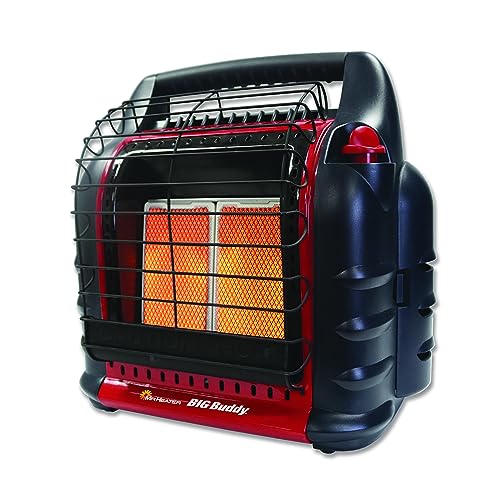
Unlike the standard Buddy, which takes one 1 lb cylinder, the Big Buddy is designed to run on two 1 lb cylinders at once when not hose-connected to a larger tank. Both cylinders feed a single regulator, and the heater draws from both roughly evenly rather than emptying one before touching the other. This is why its 1 lb-cylinder run-time figures are based on a pair, not a single cylinder — always pack them as a matched pair rather than mixing a full one with a partly used one if you want an accurate sense of remaining run time.
When to Size Down From the Big Buddy
If you find yourself running the Big Buddy on its lowest 4,000 BTU setting nearly every time you use it, that’s a signal a standard Buddy would likely serve you just as well, at a lower price and lighter carry weight. The Big Buddy earns its place specifically when you need the 18,000 BTU ceiling for genuinely larger or colder conditions, not as a default "buy the biggest one" choice. Reviewing which setting you actually use most, after a season of ownership, is a useful gut check for whether the next heater you buy should be sized up, down, or kept the same.
Choosing a Setting for Your Trip or Job
Before heading out, think through the space you are actually heating and the conditions you expect, not just the maximum number on the dial. A cold-weather ice fishing trip in a small shanty rarely needs full output. A large uninsulated garage in freezing conditions might need it the whole time. Packing an extra 1 lb cylinder or two, or bringing a hose-connect kit for a 20 lb tank, gives you the flexibility to run higher without cutting a trip short on fuel.
Maintaining a Big Buddy Over Multiple Seasons
The Big Buddy’s larger size and higher output mean a bit more upkeep than a Little Buddy over a working life spanning several seasons. Check the swivel-out feet and the regulator connection for wear before each season’s first use, since these see more stress from the unit’s added weight than a smaller model’s equivalent parts. A padded carry case, sold separately, protects the radiant element and controls during transport between a garage and a job site or hunting camp, which matters more for a heavier unit that’s harder to set down gently than a lighter model.
Big Buddy vs. Stepping Up to a Permanent Unit
If you consistently need more than the Big Buddy’s 18,000 BTU ceiling, or you’re running it at full output for hours nearly every session, that’s a sign to look at a permanent vent-free wall or cabinet heater instead of a second portable unit. Permanent units run at higher BTU tiers and connect to a larger tank or fixed line, removing the cylinder-swapping routine entirely. That’s a different kind of purchase and installation, covered in our wall-mount and cabinet heater guide, worth reading before assuming a second Big Buddy is the answer to consistently needing more heat than one unit provides.
BTU & Room-Size Calculator
Estimate the heater size you need. This is a general guide, not a substitute for the manufacturer's sizing chart.