
Affiliate disclosure: some links are affiliate links — as an Amazon Associate we earn from qualifying purchases, at no extra cost to you. Full disclosure.
A tank-top heater, also called a cylinder-mount heater, solves a specific problem: real outdoor heat with almost no setup. It screws directly onto a standard 20 lb propane tank, so there is no base to assemble and nothing to bolt to a wall. We looked at the tank-top heaters that come up most in owner reviews and ranked six worth buying. Every ranking below reflects aggregated owner reviews, manufacturer specifications, and safety certifications.

How We Picked the Best Tank Top Propane Heater
Three things mattered most. First, heat pattern and coverage, since a 360-degree swivel head suits an open space differently than a fixed double-burner design. Second, safety certification like CSA, which confirms independent testing rather than a manufacturer’s own claim. Third, what owners report about stability and ignition reliability after real outdoor use, not a first-week review.
The Short Answer
For most patios and garage bays, the Mr. Heater Original 540° 45,000 BTU Tank Top Heater is the safest starting point. Its swivel head covers more of the space than a fixed-direction design. Want independent safety certification specifically? Go with the Dura Heat TT-15CSA. Working with a smaller space? The compact Dura Heat TT-360 is sized for exactly that.

Best for A patio, open garage bay, or job site that needs real coverage from a screw-on heater
- 45,000 BTU output
- 540-degree swivel head for wide heat throw
- Screws directly onto a 20 lb propane tank
- Piezo ignition, no batteries needed
Why buy it: This is the tank-top heater owners reach for most often when they want genuine coverage without setting up a standing heater base. The swivel head throws heat almost all the way around, which suits an open patio or garage bay better than a heater that only faces one direction.
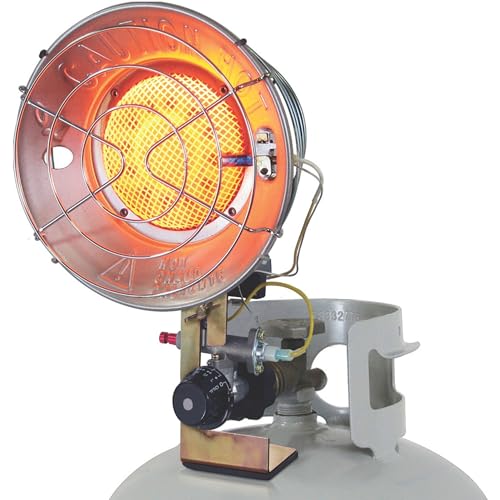
Best for Buyers who specifically want independent safety certification on a tank-top heater
- CSA certified
- Compact tank-top design
- Screws directly onto a 20 lb propane tank
- No standing base required
Why buy it: CSA certification confirms independent testing rather than just a manufacturer's own claim, and it is worth checking for on any tank-top heater. Owners specifically call this model out as the certified option that does not add much to the price over an uncertified equivalent.

Best for A smaller patio or garage bay where a full-size unit is more than needed
- 360-degree radiant heat pattern
- Compact profile under 21 inches tall
- Screws directly onto a 20 lb tank
- No electricity or batteries required
Why buy it: This is the right size for a smaller seating area that would be overwhelmed by a 45,000 BTU heater. Owners specifically mention it as the pick for a two-to-four-chair setup rather than a full dining patio or large garage bay.

Best for Buyers who want more heat throw than a single-burner unit without stepping up to 45,000 BTU
- 30,000 BTU output
- Double-burner infrared design
- Screws directly onto a 20 lb tank
- Silver finish, compact footprint
Why buy it: A double-burner layout spreads the heat source across two points instead of one, which owners say produces a more even warmth pattern across a mid-size seating area than a comparable single-burner heater at the same BTU rating.
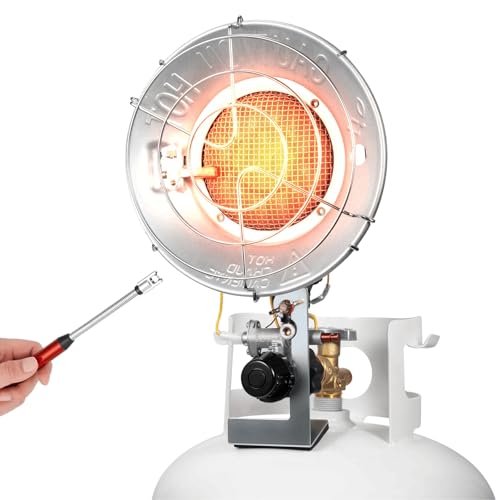
Best for Camping, small patios, and buyers who do not need more than 15,000 BTU
- 15,000 BTU output
- Windproof lighter for reliable ignition outdoors
- 3 heat settings
- Tip-over switch and shut-off valve
Why buy it: For a small space or occasional use, this covers the basics at a lower price than the bigger tank-top heaters above. Owners specifically like the windproof lighter, since a standard piezo igniter can struggle to catch in breezy outdoor conditions.

Best for Buyers who want double-burner coverage without paying for a name-brand heater
- 30,000 BTU output
- Double-burner design
- Shut-off valve and tip-over switch
- Screws directly onto a 20 lb tank
Why buy it: This delivers the same double-burner coverage idea as the pricier Avenger pick above at a lower cost, and owners comparing the two report similar real-world warmth for a patio or garage bay setup.
Full Comparison
All six picks side by side. "Best for" reflects the specific space each heater is most consistently recommended for in owner reviews.
| Product | Best for | Buy |
|---|---|---|
| Mr. Heater Original 540-Degree 45,000 BTU Tank Top Radiant Propane Heater | Best Overall | Check Price |
| Dura Heat TT-15CSA Tank Top Heater | Best CSA-Certified Pick | Check Price |
| Dura Heat TT-360 Propane 360 Degree Tank Top Heater | Best Compact 360° Heater | Check Price |
| Avenger FBDTP30 Infra-Red Tank Top Outdoor Heater, Double Burner, 30,000 BTU | Best High-Output Double Burner | Check Price |
| GasBRUH Single Tank Top Propane Radiant Heater With Windproof Lighter, 15,000 BTU | Best Budget Single-Burner | Check Price |
| GasBRUH Double Tank Top Outdoor Propane Heater, 30,000 BTU | Best Budget Double-Burner | Check Price |
Tank Top Heater vs. Wall-Mount vs. Standing: Where This Style Fits
A tank-top heater sits in a different niche than the fixed vent-free heaters covered on our wall-mount and cabinet heater guide. It's also different from a standing patio heater with its own base. It sets up and breaks down in minutes rather than requiring installation.
No Oxygen Depletion Sensor: Why This Style Is Outdoor Heat Only
It is outdoor-rated, not indoor-safe. None of these six picks include an oxygen depletion sensor, the feature that makes a heater indoor-safe.
A Weather Resistant Housing Matters More Outdoors
Look for a genuinely weather resistant housing, since these heaters see far more outdoor exposure than a wall-mount unit. If you need something semi-permanent and outdoor, tank-top is the category. If you need indoor, fixed heat for a full season, look at wall-mount instead.
Radiant Heat Patterns: 360 Degree Adjustable Head vs. Double Burner Directional Heat
A 360-degree swivel head, like the top pick above, throws heat in a wide arc around the tank, which suits a group of people seated around it or an open garage bay where direction is less predictable. That swivel head is an adjustable head design that rotates through most of a circle rather than locking to one direction. A double-burner design concentrates more directional heat from two fixed points instead, which some owners say feels more even across a specific seating cluster but covers a narrower overall area than a full swivel design. Whether you land on a single burner or double burner model comes down to your seating layout more than BTU alone. Neither is universally better; it depends on how your space is actually laid out.
Stability: The Cylinder-Mount Heater’s Biggest Weakness
Because a tank-top heater’s entire weight sits on top of the tank rather than a wide base, tank stability matters more here than for any other heater style. Placing the tank on a level, solid surface reduces the risk of the whole assembly tipping. Soft ground, gravel, and uneven deck boards are the main culprits, and several reviews specifically flag this as a real consideration for outdoor or job-site use where the ground is not always flat.
CSA Certified, Tip-Over Shut-Off, and Clearance to Combustibles
CSA certification, which the Dura Heat TT-15CSA carries explicitly, means the heater passed independent testing against a recognized safety standard rather than relying only on the manufacturer’s own claims. It is worth checking for on any tank-top heater you are considering, alongside a working tip-over shut-off, which most modern models include as close to a baseline expectation for the category. Keep proper clearance to combustibles per NFPA 58 guidance whenever running one of these heaters near a structure, tent, or vehicle.
Windproof Lighter vs. Piezo Ignition for Outdoor Use
A standard piezo igniter can struggle to catch in breezy conditions, which is a real annoyance on an exposed patio or job site. Some newer tank-top heaters, including the GasBRUH budget pick above, add a windproof lighter specifically to solve this. If you have ever fought with a heater that will not light on a windy evening, this feature is worth prioritizing over a small price difference.


BTU Sizing for a Tank-Top Heater
A 15,000 BTU single-burner heater suits a small patio or camping setup for a couple of chairs. A 30,000 BTU double-burner heater covers a mid-size seating area better without stepping up to full 45,000 BTU output. The 45,000 BTU swivel-head tier is the right call for a genuinely open space, like a full patio or an open garage bay, where you need heat reaching multiple directions at once. Our patio heater BTU guide covers this sizing math in more depth.
Buying Checklist: Tip-Over, OPD Valve and 20 lb Tank
- Match the heat pattern to your space — a swivel head for open areas, a double-burner or single-burner for a defined seating cluster.
- Check for CSA or a comparable certification plus a working tip-over shutoff.
- Place the tank on level, solid ground to avoid a real tip-over risk.
- Consider a windproof lighter if your space is regularly breezy.
- Budget for a 20-lb propane tank separately if you do not already own one that meets current OPD-valve refill requirements.
Running Cost and Tank Life
Using the standard conversion of roughly 21,600 BTU per pound of propane, a 45,000 BTU tank-top heater running at full output empties a 20 lb tank in a little over 9 hours. A 15,000 BTU single-burner unit on the same tank stretches closer to 28 hours. Most people do not run a tank-top heater at full output continuously, and models with adjustable heat settings stretch tank life considerably further than that full-burn figure suggests.
What Owners Report: Best Value and Heat Output
Across reviews, the higher-output swivel-head models draw consistent praise for coverage in open outdoor spaces, with the main complaint being ignition hesitation in wind on models without a windproof lighter. The compact and budget picks draw praise specifically from buyers who wanted something simple for a smaller space and did not want to pay for coverage they would never use. Stability on uneven ground is the most common complaint across the whole category, regardless of price or brand. For best value without sacrificing real heat output, the GasBRUH double-burner pick delivers comparable warmth to the pricier Avenger at a lower cost.
Maintenance Between Uses
A tank-top heater used outdoors picks up dust, pollen, and moisture faster than an indoor heater. Wipe down the burner head and swivel joint periodically, and check the connection threads for corrosion before each new season. A heater stored outdoors uncovered through winter is far more likely to develop connection problems the following spring than one stored in a dry space with the tank disconnected.
Setting Up on a Job Site, Garage Bay or Patio
A job site places different demands on a tank-top heater than a patio does. Job-site use means more frequent moves, more exposure to dust and debris, and less predictable ground conditions. A patio setup tends to stay in one spot for a whole season, on a more consistent surface like a deck or a paved area. If you are buying primarily for job-site use, weigh the heater’s ruggedness and stability features more heavily than you would for a patio-only purchase.
Storage Between Seasons
Disconnect the tank before storing a tank-top heater for the off-season, the same way you would for any propane appliance. This reduces stress on the hose and connection point from temperature swings and prevents a slow leak from going unnoticed over months of storage. Store the heater itself somewhere dry rather than leaving it outdoors uncovered, since exposure to rain and snow accelerates wear on the burner assembly and swivel joint.
Brass Burner Heads: Does Brand Matter More Than Specs?
Within the tank-top category, established brands like Mr. Heater, Dura Heat, and Dyna-Glo (whose RMC-TT is another commonly compared tank-top model) carry a reputation for consistent ignition and long-term reliability that shows up repeatedly across owner reviews. Camping brands like Ozark Trail don't currently sell a dedicated tank-top heater, leaving this category to brands built specifically around heaters. A brass burner head, on models that offer one, resists corrosion better than painted steel across repeated outdoor storage cycles and is worth checking for regardless of brand. Newer, less established brands at similar price points and specs sometimes match that performance and sometimes do not, and it is harder to predict from specs alone. If reliability matters more to you than saving a small amount upfront, leaning toward an established brand is a reasonable way to reduce that uncertainty.
Regulator, POL Connector, and 20-lb Propane Tank Hose Kits
Some owners add an aftermarket hose kit to a tank-top heater. Confirm the regulator and hose match your tank's connector type first — older systems use a POL connector, while most current 20-lb propane tank setups use a QCC1/Type 1 fitting with an OPD valve. This lets the tank sit further away, out of the direct heat path, while keeping the same burner head, at the cost of a small amount of setup complexity a tank-top design is meant to avoid.
Using a Tank-Top Heater on a Boat or RV
Tank-top heaters see occasional use on boats and RVs for supplemental outdoor heat, though they are not designed or rated for use inside an RV or cabin space the way a dedicated RV furnace is. Treat a tank-top heater as strictly an outdoor accessory in this context, used on a deck or in an open cockpit area, never inside an enclosed RV or boat cabin. Our RV and off-grid heater guide covers heaters actually built for that indoor use case.
What to Do If Ignition Becomes Unreliable
A tank-top heater that used to light easily but now needs several tries is usually signaling a dirty or worn piezo igniter rather than a fuel problem. Check the igniter tip for corrosion or debris buildup first, since this is the most common and easiest fix. If cleaning does not help, compare against your tank’s fuel level and the connection’s seal before assuming the whole heater needs replacing.
The Bottom Line: Swivel Head, Single Burner or Double Burner
A tank-top heater earns its place in this category by trading a wide base and maximum stability for speed and simplicity. For most patios, garage bays, and job sites, that tradeoff is worth it. For a windy, exposed, or genuinely uneven space, weigh the stability tradeoff carefully before committing, and consider a hose-connected standing heater instead if ground conditions are a real concern for your specific setup.
One Last Check Before You Buy
Confirm the specific model ships with piezo ignition rather than requiring a separate lighter, since this is standard on nearly every tank-top heater but worth a quick check before ordering. Also confirm the connection thread matches a standard 20 lb propane tank, since a small number of specialty models use a different fitting. These two checks take a minute and prevent an easily avoidable return.