
Affiliate disclosure: some links are affiliate links — as an Amazon Associate we earn from qualifying purchases, at no extra cost to you. Full disclosure.
Looking for the full spec breakdown and verdict on the Little Buddy itself? Read our complete Mr. Heater Little Buddy review →
The Little Buddy is the entry point into Mr. Heater’s Buddy lineup: a single 3,800 BTU setting, no dial, no adjustment — just on or off. It’s the lightest and least expensive Buddy model, which makes it the obvious starting question for anyone shopping this brand-series hub: is "little" actually the right size, or does the step up to the Buddy or Big Buddy make more sense for what you’re actually heating? This page focuses on that buying decision. For the full spec breakdown, owner-reported pros and cons and complete verdict on the Little Buddy itself, see our dedicated Little Buddy deep-dive review.
Top 3 Recommended
Where the Little Buddy Fits in the Buddy Family
Mr. Heater’s Buddy series scales roughly like this: Little Buddy at a fixed 3,800 BTU, the standard Buddy (also sold as the Portable Buddy) at 4,000–9,000 BTU across two settings, and the Big Buddy topping out at 18,000 BTU across three settings with dual-cylinder capability. The Little Buddy is the only model in the family with no adjustment — you get 3,800 BTU or nothing. That single fact is the entire buying decision: if a space is small enough that 3,800 BTU comfortably heats it, the Little Buddy’s lighter weight and lower price win. If there’s any chance the space needs more heat on a colder night, the two-setting Buddy is the safer buy, because it can also run at a similar low output when 9,000 BTU is too much.
Who Should Buy the Little Buddy Specifically
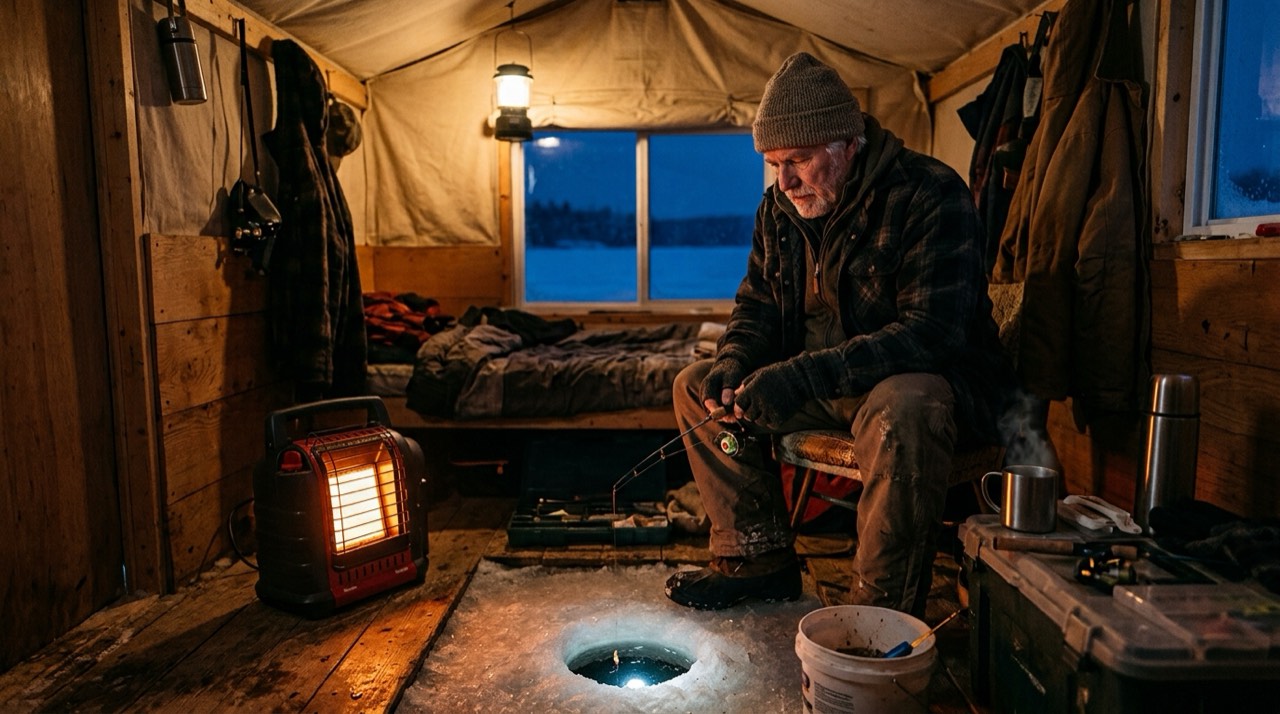
The Little Buddy makes the most sense for a single person in a genuinely small enclosed space — a one-person ice-fishing shanty, a car or truck cab, a small dog house or coop, or a compact one-person tent. Its lack of adjustability is a feature, not a limitation, for exactly this use case: there’s nothing to accidentally set too high in a small space, and the fixed low output means it sips fuel compared to running a bigger heater on its lowest setting. It’s the wrong buy for anyone heating more than one small room or a mid-size tent — see the standard Buddy/Portable Buddy family instead, reviewed separately in this hub.
Full Specs
| Spec | Detail |
|---|---|
| BTU output | 3,800 BTU (fixed, single setting) |
| Coverage | Up to 95 sq ft |
| Fuel | One 1 lb. cylinder |
| Runtime | Approx. 5–7 hours per cylinder |
| Weight | Approx. 5.25 lbs |
| Safety | Oxygen Depletion Sensor (ODS), accidental tip-over shut-off |
| Ignition | Piezo igniter |
Source: Mr. Heater official product listing. Full sourced spec table and owner-reported detail in the dedicated Little Buddy review.
Sizing It Against the Rest of the Lineup
Compared to the standard Buddy at 225 sq ft coverage and up to 9,000 BTU, the Little Buddy covers less than half the space at a fraction of the weight. Compared to the Big Buddy at 450 sq ft and 18,000 BTU with dual-cylinder capability, it’s a different category entirely — the Big Buddy is built for cabins and garages, the Little Buddy for a single occupied corner. Owner feedback aggregated across the lineup consistently points to the same pattern: buyers who size down to the Little Buddy for cost savings, then find themselves cold in anything larger than a one-person space, tend to end up buying a second, bigger Buddy anyway. Sizing up front, even at a higher price, usually saves a second purchase.

The Buying-Decision Checklist
- One person, one small enclosed space (car, shanty, small tent)? Little Buddy is the right size and the lightest option to carry.
- Mid-size tent, small cabin, or two people? Step up to the standard Buddy / Portable Buddy — its adjustable low setting covers the same small-space use case with room to grow.
- Garage, workshop or a cabin over 300 sq ft? The Big Buddy is the only model in the family built for that scale.
- Budget is the deciding factor? The Little Buddy is the least expensive Buddy model, but confirm the space genuinely fits its 95 sq ft rating before buying on price alone.
What "Fixed Output" Actually Feels Like
Because the Little Buddy has no low setting, owners describe its practical behavior less in terms of temperature control and more in terms of "on" versus "off" time. In a genuinely small, well-sealed space — a car cab, a compact ice shanty, a one-person tent with the rainfly down — 3,800 BTU running continuously tends to overshoot comfortable within 20 to 30 minutes, at which point owners cycle it off and on rather than leaving it running the whole time. That behavior is specific to fixed-output heaters and worth knowing before buying: anyone who wants a heater they can dial down and leave running continuously at low output is better served by the adjustable standard Buddy, even in a space small enough that the Little Buddy would technically cover it.
Weight and Portability Trade-Off
At roughly 5.25 lbs, the Little Buddy is meaningfully lighter than the standard Buddy’s typical carry weight, a difference that matters most to backpackers, hunters walking into a stand, or anyone prioritizing pack weight over heat flexibility. For car camping, tailgating or any use case where the heater rides in a vehicle rather than a pack, that weight difference matters much less, and the extra capability of the adjustable Buddy models usually outweighs the modest weight savings.
Verdict
The Little Buddy earns its place in the lineup as the right tool for a genuinely small, single-occupant space — not as a budget shortcut for a bigger job. If the space in question is a car cab, small ice shanty or a compact one-person tent, it’s hard to beat on weight and simplicity. For anything larger, sizing up to the standard Buddy costs relatively little more and avoids the common regret of buying too small the first time. See our full Little Buddy review for the complete owner-reported pros, cons and long-term ownership notes.

Best for One person in a small tent, ice-fishing shanty or car interior
Related Products
See our Best Mr. Heater Buddy Model roundup and Little Buddy vs Buddy vs Big Buddy comparison for a side-by-side sizing breakdown, or the full Mr. Heater Buddy series guide. Pair a Little Buddy purchase with these: