
Affiliate disclosure: some links are affiliate links — as an Amazon Associate we earn from qualifying purchases, at no extra cost to you. Full disclosure.
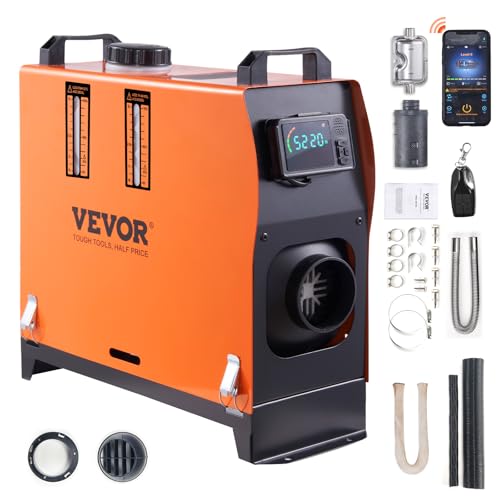
VEVOR sells several distinct 8KW diesel heater listings. Each targets a slightly different use case. This one is built specifically with garage use in mind. It runs on either 12V or 24V power. It has Bluetooth app control, a remote, and a display screen. It also ships with a built-in carbon monoxide alarm. That’s genuinely useful for a fixed garage setup, more so than in a vehicle where you’re rarely far from fresh air.

Top 3 Recommended
Who It’s For
This heater fits a detached garage, workshop, or barn on a budget. The dual 12V/24V voltage support makes it flexible for different power setups. The built-in CO alarm is a real advantage for a space where you work for hours at a stretch. It’s not the right choice for a vehicle install. The separate general-use VEVOR model reviewed elsewhere on this site fits that job better. Anyone who wants an established brand with a longer track record should look at Espar or Webasto instead.
Why the Built-In CO Alarm Matters Here
A diesel air heater’s combustion is sealed and vented outside. That’s the core of its safety design. But an exhaust leak, a blockage, or an installation error can still let carbon monoxide into the space. A dedicated CO alarm inside the garage is the backstop against that failure. This model includes one built in. You don’t need a separate purchase for it. That’s a genuinely useful inclusion for garage use specifically. People often work alone there for hours, with nobody else around to notice symptoms of exposure.
A Fixed Garage Install vs a Vehicle Install
A garage install differs from a vehicle install in one big way. The heater and the space never move. That makes longer, more permanent fuel and exhaust runs the norm rather than the exception. It also means you can mount a proper wall-height CO detector, something harder to place well inside a cramped van. A garage-specific listing like this one, built with those differences in mind, is usually the better starting point than a general vehicle-focused kit.
Full Specs
| Spec | Detail |
|---|---|
| Output | 8KW |
| Voltage | 12V or 24V |
| Control | Bluetooth app, remote, display screen |
| Safety | Built-in CO alarm |
| Fuel | Diesel |
Source: manufacturer specifications per the Amazon product listing.
What Owners Praise
The built-in CO alarm is the single most-praised feature on this listing. Owners who installed it in a garage say the peace of mind alone is worth choosing this over a similar VEVOR unit without one. The dual 12V/24V voltage support also gets regular praise. It works with more power setups without needing an adapter. The app control and display screen round out a feature set owners call strong for the price. That’s especially true compared to established European brands at several times the cost.
What Owners Report as Drawbacks
Installation complexity is the most common complaint, consistent with diesel heaters generally. Running the fuel line and exhaust correctly takes real time and mechanical comfort. A second theme is the built-in CO alarm itself. It’s a good safety addition, but it isn’t a substitute for a separate detector placed at breathing height in the room. Some owners note the alarm’s placement on the unit isn’t ideal for that purpose. A smaller group mentions needing to source their own mounting hardware for a garage wall install.
Pros & Cons
Pros
- Built-in CO alarm, a genuine safety plus for garage use
- Works on both 12V and 24V power systems
- Bluetooth app control plus a physical remote and display
- Competitive price against established European brands
Cons
- Installation still requires real fuel line and exhaust work
- Built-in alarm doesn’t replace a separate, well-placed CO detector
- Mounting hardware for a garage wall install may need to be sourced separately
- Shorter brand track record than Espar or Webasto
Installation and Maintenance
Follow the manual’s exact fuel line and exhaust routing guidance for a garage install. A fixed structure often means longer runs than a vehicle install. Mount the unit securely to a wall or stable surface rated for its weight. Test the built-in CO alarm regularly. Don’t treat it as a full substitute for a separate detector placed at breathing height in the room. Clean or replace the fuel filter on the manufacturer’s schedule. Inspect exhaust connections each season.
How It Compares
Against the general-use VEVOR model reviewed separately on this site, this one adds the CO alarm and dual-voltage support. Both are genuinely useful for a fixed garage install specifically. Against Espar’s garage-focused Airtronic M2 D4 reviewed elsewhere in this hub, this VEVOR model costs meaningfully less. It carries a shorter reliability track record in exchange, with no built-in scheduling or fault diagnostics.
Exhaust Safety Is Non-Negotiable
Route the exhaust completely outside the garage, with no exceptions. Keep the outlet clear of windows, doors, and any air intake. Install a separate, dedicated carbon monoxide detector inside the garage at breathing height, in addition to the unit’s built-in alarm. That’s a backstop against an unexpected leak, not a substitute for a correct install. Inspect the exhaust route at the start of each heating season.
Choosing Between the Two VEVOR Listings
Pick this garage-focused listing if the heater stays in one fixed structure and you value the built-in CO alarm and dual-voltage flexibility. Pick the general-use VEVOR model reviewed separately on this site if you’re installing in a vehicle, where the altitude adjustment feature matters more than a stationary CO alarm. Both share the same core 8KW diesel air heater design underneath the different feature sets.
Verdict
For a detached garage or workshop on a budget, this VEVOR model is a genuinely sensible pick. Its built-in CO alarm and dual-voltage flexibility back that up. It won’t match Espar’s diagnostics or Webasto’s track record. It still delivers real, garage-relevant safety features at a fraction of the cost. Anyone installing in a vehicle instead should choose the general-use VEVOR model reviewed separately on this site.

Best for Detached garages and workshops on a budget, with a built-in CO alarm
Related Products
See our full diesel heater guide for how this compares across the category, or our installation basics guide before you start. Pair it with these: