
Affiliate disclosure: some links are affiliate links — as an Amazon Associate we earn from qualifying purchases, at no extra cost to you. Full disclosure.
Most propane heaters sold in the US are not rated for indoor use. The box photo will not tell you that. "Portable" does not mean "safe indoors." Those are two different claims. Here is how to actually check which category a specific model falls into, using the manual rather than the marketing.
Top 3 Recommended
The Fastest Way to Check a Specific Model
Start with the actual product manual. Most brands publish these as free PDFs on their support pages. Look for the words "for indoor use," "vent-free," or "unvented." Those words should sit next to a description of an oxygen depletion sensor, or ODS. If neither shows up, treat the heater as outdoor-only. Same goes if the manual says "for outdoor use only" or "well-ventilated area only." Retail titles are not always precise about this. The manual is the real source of truth.
The Standard Behind the "Indoor-Safe" Label
In the US, unvented gas room heaters are built to a standard called ANSI Z21.11.2. This standard covers indoor-safe portable propane heaters and vent-free wall units. It requires an oxygen depletion sensor. That sensor cuts gas flow to the burner once the room’s oxygen drops to about 18%. That is well before oxygen reaches a dangerous level.
The same standard also limits heat output. General indoor use is capped at 40,000 BTU/h. A heater built for a bedroom is capped lower, at 10,000 BTU/h. One built for a bathroom is capped lower still, at 6,000 BTU/h. Why the lower numbers? Bedrooms and bathrooms are usually smaller. They get sealed up for privacy or warmth. And someone in them might be asleep, or slow to notice a problem. A smaller, lower-output heater makes sense in that setting.
Heater Categories That Are Typically Indoor-Safe
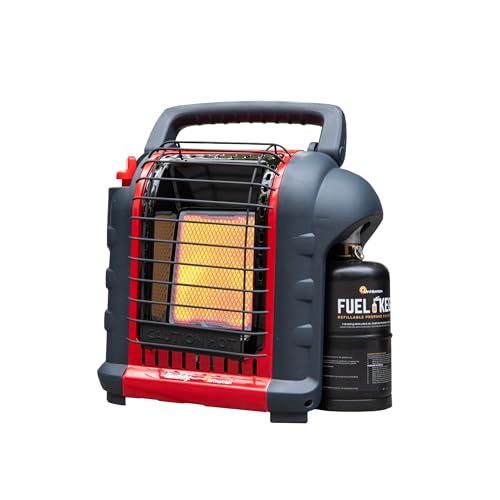
Portable radiant heaters built around an ODS are usually indoor-safe. The Mr. Heater Buddy lineup is the best-known example. These are certified for indoor or enclosed-space use, as long as you follow the ventilation and room-size guidance in the manual. Permanent vent-free wall and cabinet heaters fall into this same certified category, just at higher BTU tiers for larger rooms. See our Mr. Heater Buddy series guide and wall-mount and cabinet heater guide for model-specific detail.
Heater Categories That Are Typically Outdoor-Only
Forced-air construction heaters have no ODS at all. They are labeled outdoor-use or active-ventilation-only for a reason. See our forced-air heater guide for that category. Tank-top radiant heaters and standing patio heaters are outdoor-only too. Their open-flame design has no oxygen safety shutoff built in. That makes them unsuitable for any enclosed space, even briefly. Our patio heater guide covers that category on its own.
Opening a Window Does Not Change the Rating
More airflow is not the same as an ODS. An outdoor-only heater simply does not have one. There is no way to add one after the fact. It has to be built in from the start and tested as part of certification. If a manual says outdoor-use-only, a cracked window does not change that. The rating comes from the hardware inside the unit, not from how much air moves through the room.
Checking a Listing Before You Buy
- Read the manual, not just the title. Look for "ODS," "oxygen depletion sensor," "vent-free," or "unvented."
- Note the exact room type it is cleared for. General indoor use is different from a bedroom-rated unit.
- Check the minimum room size. An indoor-safe heater can still be wrong for a very small, sealed room.
- Confirm the fuel type. Some ODS heaters run on propane only. Others switch between propane and natural gas with a kit.
- Call the manufacturer if you are unsure. Use the exact model number, not a general search term.

What to Do If You Already Own an Outdoor-Only Heater
Do not try to use it indoors, even for a few minutes. The honest fix is buying a second heater built for that purpose. Our BTU sizing guide can help size an indoor-safe replacement once you know it needs an ODS from the start.
A Quick Comparison
Think of it this way: an indoor-safe heater is built with three things an outdoor-only heater lacks — the ODS itself, a certification tied to a specific room type, and a manual that says so in plain language. If a listing cannot show you all three, do not assume the heater is safe indoors just because it is small or looks similar to one that is.
Why the Same Brand Sells Both Kinds
It trips buyers up constantly: a brand that makes an indoor-safe portable radiant heater also sells an outdoor-only tank-top or forced-air model, sometimes with a similar name or nearly identical housing. That is because certification happens at the individual model level, not the brand level, and a manufacturer has no reason to certify every product line to the stricter indoor standard if most of them are built for job sites or patios. Never assume that because one heater from a brand is indoor-safe, a different model from the same brand automatically is too. Check each model on its own, every time, using the manual rather than brand reputation.
What a Retailer’s "Indoor/Outdoor" Wording Really Means
Some listings use the phrase "indoor/outdoor" loosely, meaning the heater is portable enough to move between a garage and a patio, not that it is certified safe to run sealed up indoors. That is a meaningful difference, and it is worth reading past the headline phrase into the actual spec sheet or manual before assuming a heater qualifies. When a listing is genuinely ambiguous, the manufacturer’s own support site almost always states the certification plainly, since it matters for their liability as much as for your safety.