

Affiliate disclosure: some links are affiliate links — as an Amazon Associate we earn from qualifying purchases, at no extra cost to you. Full disclosure.
Comparing a radiant heater’s BTU rating directly against a forced-air heater’s is one of the most common mistakes first-time buyers make, because the number on the box means something different depending on how the heater delivers that energy.

Top 3 Recommended
Same BTU Number, Different Real-World Output
A 9,000 BTU radiant heater and a 9,000 BTU forced-air heater produce the same amount of total heat energy per hour, but they deliver it completely differently. The radiant heater concentrates that energy on whatever’s directly in its path — a person, a chair, a workbench. The forced-air heater spreads the same energy across a moving volume of air that has to actually stay in the space and build up temperature. For a person sitting directly in a radiant heater’s path, the radiant unit often feels warmer despite the identical BTU rating.
A Real Comparison: Buddy Heater vs. Construction Heater
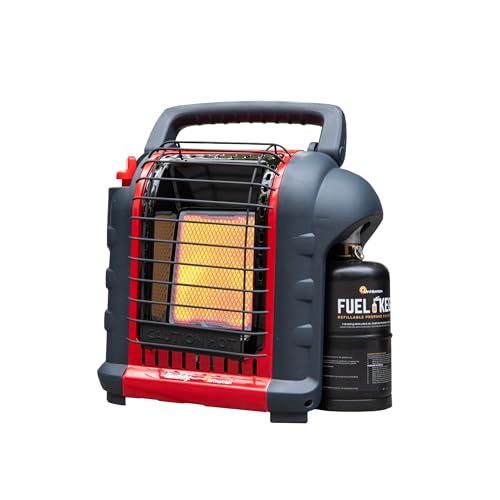
The standard Mr. Heater 9,000 BTU Portable Buddy and a construction-grade forced-air unit rated at 60,000–70,000 BTU illustrate the gap well. The forced-air unit puts out roughly seven times the total energy, and that’s appropriate given its job: raising the ambient temperature of an entire large, uninsulated garage or job site. But for warming one person standing near it in an open space, the much smaller radiant heater can feel comparably effective, because it isn’t fighting the same ambient heat loss the forced-air unit’s warmed air constantly loses to open or drafty conditions.
Why Manufacturers Publish BTU Differently by Category
Radiant heaters in the portable category, like the Buddy line, typically top out around 18,000–30,000 BTU for the largest portable and vent-free wall models, because that’s roughly the ceiling where the safety margins for an ODS-equipped design and the practical fuel logistics of cylinder or small-tank feeding still make sense. Forced-air construction heaters routinely rate at 100,000–150,000+ BTU, because their entire design goal is raising a large room’s temperature quickly, which requires that much more raw output when working against convective heat loss in an open or uninsulated space.
Coverage Area: Another Place the Numbers Don’t Translate
A forced-air heater’s published coverage area (often stated in square feet for a specific room) reflects its ability to raise the whole room’s air temperature. A radiant heater doesn’t really have an equivalent "coverage area" in the same sense — its effective reach is more about the radiant element’s throw distance and the angle it’s aimed at, not a room-filling volume. When you see a radiant heater’s spec sheet list a coverage figure, it’s typically describing a much smaller, more direct zone than a forced-air heater’s room-coverage number implies.
When the BTU Gap Actually Matters for Your Decision
If you’re deciding between a radiant and a forced-air heater for the same space, the BTU numbers on their own won’t tell you which is the better fit — the use case does. For warming a person or a defined work area, a much lower-BTU radiant heater can outperform a higher-BTU forced-air unit. For raising an entire large room’s ambient temperature, the forced-air heater’s higher BTU rating reflects a genuine advantage the radiant heater’s design can’t match regardless of how high a radiant model’s BTU rating climbs.
A Practical Rule of Thumb
As a rough guide that shows up consistently in owner comparisons, a radiant heater can feel roughly equivalent to a forced-air heater rated meaningfully higher — sometimes double or more — when the use case is warming a person directly rather than an entire room. This isn’t a precise conversion factor, since it depends heavily on how enclosed the space is and how directly the radiant heat is aimed, but it explains why a 9,000 BTU Buddy heater satisfies owners in scenarios where a spec-sheet comparison alone might suggest it’s underpowered.

How Owners Discover This the Hard Way
A common pattern in owner reviews: someone buys a higher-BTU forced-air heater expecting it to obviously outperform a smaller radiant unit for personal warmth, only to find the radiant heater they already owned felt just as effective for sitting near while working on a project. The reverse pattern also shows up — someone buys a radiant heater expecting it to warm an entire garage the way their old furnace did, and comes away disappointed because that was never what radiant heat was designed to do. Both patterns trace back to the same BTU-comparison confusion this page addresses.
A Real-World Example: Sizing for a Two-Car Garage
Someone heating a two-car garage might see a radiant heater rated at 30,000 BTU and a forced-air heater rated at 60,000 BTU marketed for a similar-sized space, and reasonably wonder why the forced-air unit needs double the output for the same room. The answer is the mechanism: the radiant heater’s 30,000 BTU is concentrated on whatever’s directly in its path, leaving much of the garage’s air volume untouched, while the forced-air heater’s 60,000 BTU is spread across raising the entire room’s temperature. For actually warming the whole garage rather than a specific workbench, the forced-air unit’s higher rating reflects genuine additional capability, not inefficiency.
Why This Confuses First-Time Buyers Specifically
Most other appliances people buy — space heaters, air conditioners, even car engines — use a single spec number that scales roughly linearly with capability within the same category. Propane heaters break that intuition because two entirely different heat-transfer mechanisms share the same unit of measurement (BTU) despite delivering fundamentally different practical outcomes. This is worth understanding explicitly rather than assuming your experience comparing, say, air conditioner BTU ratings transfers directly to comparing propane heaters across categories.
Manufacturer Coverage Claims Reflect This Difference Too
When you see a radiant heater’s spec sheet claim coverage for "up to 200 sq ft" alongside a forced-air heater claiming "up to 1,700 sq ft" at a similar or even lower BTU rating in some cases, that’s not a typo or inconsistent testing — it reflects the fundamentally different way each heater distributes its energy across a space. Cross-check any coverage claim against the heater’s category (radiant, forced-air, catalytic) rather than treating coverage figures as directly comparable numbers across different heating mechanisms, since a listing’s coverage figure is only meaningful within its own product category. When in doubt, owner reviews describing real-world results in a comparable space are more reliable than the spec sheet’s coverage claim alone, since they reflect actual conditions rather than a controlled test environment.
Don’t Let BTU Alone Drive Your Decision
Given how differently these two heater types translate BTU into felt warmth, the more useful starting question isn’t "which has more BTU" but "am I warming a person or a room." Answer that first, then compare BTU ratings only within the resulting category — radiant-to-radiant or forced-air-to-forced-air — rather than across the two fundamentally different heating mechanisms.

Related Reading
For the full mechanical explanation behind this BTU gap, see our radiant vs. forced-air heat guide. For why radiant heat specifically feels warmer at lower BTU, see why radiant heaters feel warmer at lower BTU.