
Affiliate disclosure: some links are affiliate links — as an Amazon Associate we earn from qualifying purchases, at no extra cost to you. Full disclosure.
A faint propane smell for a second or two right at ignition is normal and expected — it’s a small amount of unburned gas released before the flame catches. A smell that lingers, comes back, or is strong at any point is not normal and should be treated as a possible leak. Here’s how to tell the two apart and exactly what to do.
Why Propane Smells Like Anything at All
Pure propane has almost no smell. Manufacturers add a chemical odorant — usually ethyl mercaptan — specifically so a leak announces itself to your nose before it reaches a dangerous concentration. That’s why a propane leak is often described as smelling like rotten eggs or sulfur; that’s the added odorant, not the fuel itself. Our safety systems explainer covers this and two other built-in safeguards in more depth.
Normal: A Brief Smell Right at Lighting
When you open a valve or press an igniter, a small amount of propane is released before the spark catches it and it starts burning. That brief whiff, gone within a second or two once the flame is steady, is expected and not a sign of a problem. It happens on essentially every propane appliance, not just heaters.
Not Normal: A Smell That Lingers or Returns
A smell that continues after the flame is lit, comes and goes while the heater runs, or is noticeably strong rather than faint, means gas is escaping somewhere it shouldn’t be. Treat this as a genuine leak until proven otherwise — not something to keep using the heater while you "keep an eye on it."
Step 1: Turn the Heater Off Immediately
Shut off the heater’s own control valve first, then close the tank or cylinder valve completely. Don’t try to relight it or adjust settings while the smell is present.
Step 2: Ventilate the Space
Open windows and doors and leave the area for several minutes before returning to investigate further. Don’t operate light switches or anything that could create a spark while a strong gas smell is present in an enclosed room.
Step 3: Find the Source With a Soap Test
With the tank valve back open but the heater’s own valve still off, mix a few drops of dish soap with water and brush it onto every connection point: the tank valve, the hose fittings, the regulator, and where the hose meets the heater. Bubbles forming at a connection point to the source of the leak. This test works because propane pushes through the soap film and forms visible bubbles at even a small leak point that you’d never see or hear otherwise.
Step 4: Tighten or Replace What’s Leaking
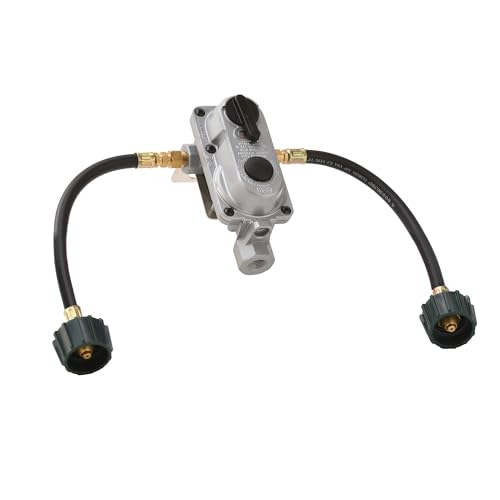
A loose connection that bubbles can sometimes be fixed by hand-tightening, plus a light quarter-turn with a wrench if needed — don’t overtighten, which can damage the fitting. A hose or regulator that bubbles along its length, rather than just at a connection point, has failed and needs replacement; it isn’t a tightening fix. A regulator with a built-in excess-flow safety feature, like the option below, is a reasonable upgrade when replacing one.

Step 5: Recheck Before Relighting
After tightening or replacing the leaking component, repeat the soap test on that connection specifically before relighting the heater. Don’t just assume a single tightening pass solved it — confirm with the same test that found the leak in the first place.
When the Smell Only Happens With a New Tank
A gas smell that started right after connecting a fresh cylinder often traces to the connection itself not being fully seated, rather than a failing hose or regulator that had worked fine before. Disconnect and reconnect the tank, making sure the fitting threads on fully and squarely before tightening, then soap-test that one connection again.
Can a Weak Sense of Smell Miss a Leak?
Yes, and this is a genuinely documented limitation of relying on odor alone. Age, a cold, allergies or simply a less sensitive sense of smell can all reduce how reliably someone detects the added odorant, and the odorant itself can fade slightly in fuel that’s sat for a long time in a tank. This is one more reason the soap test matters — it doesn’t depend on anyone’s nose, and it’s worth using any time you suspect a leak even faintly rather than relying entirely on smell to confirm or rule it out.
Does a Gas Smell Mean the Same Thing as a Carbon Monoxide Risk?
No — they’re different hazards from different causes, and it’s worth not conflating them. A gas smell means unburned propane is escaping somewhere before combustion. Carbon monoxide is a byproduct of incomplete combustion inside a heater that’s already running, and it has no smell of its own. A heater can have a CO problem with zero gas smell, and a gas leak with zero CO risk if it’s never ignited. Our CO alarm guide covers that separate scenario.
What If You Can’t Find the Source?
If the soap test doesn’t turn up an obvious bubbling point but the smell persists, don’t keep troubleshooting on your own — an internal valve or manifold leak inside the heater itself is possible and isn’t something a soap test on external fittings will catch. Leave the tank valve closed, ventilate the space fully, and have the heater inspected by a qualified technician or contact the manufacturer before using it again.
Storing Tanks and Hoses to Prevent Future Leaks
Hoses and O-rings degrade with age and temperature exposure even in storage, not just during active use — a heater that worked fine last season can develop a slow leak purely from a hose sitting through a hot summer or a freezing winter in a shed. Inspecting hose connections and doing a quick soap test at the start of each new season, before you actually need the heat, catches most of these before they become a mid-use surprise.
When This Becomes an Emergency, Not a Repair Job
If the smell is strong immediately upon opening the tank valve, if you hear a hissing sound alongside the smell, or if the smell doesn’t clear after ventilating and closing the valve, leave the area and treat it as an active gas leak — contact your local fire department’s non-emergency line or gas utility for guidance rather than continuing to investigate the connections yourself.