
Affiliate disclosure: some links are affiliate links — as an Amazon Associate we earn from qualifying purchases, at no extra cost to you. Full disclosure.
Every indoor-safe propane heater lists a BTU rating on the box, but that number only means something once you match it to the room you’re actually heating. Undersize it and the heater runs constantly without keeping up. Oversize it and you’re not just wasting fuel — in an enclosed space, more heat output than the room needs makes oxygen and ventilation management harder to balance, which is a real consideration for a ventless appliance, not just a comfort one.
Top 3 Recommended
The Baseline Rule: BTU per Square Foot, Indoors
As a starting point that shows up consistently across manufacturer sizing guidance, a well-insulated interior room needs roughly 20–30 BTU per square foot to reach and hold a comfortable temperature. A drafty room, one with a high ceiling, or one with a lot of exterior wall or window area needs more — sometimes meaningfully more. This range is a starting point for indoor-safe (ODS-equipped) heaters specifically; outdoor and semi-outdoor spaces lose heat differently and need a different calculation, covered in our outdoor patio heater BTU guide.
Room Size to BTU: A Practical Table
Using the 20–30 BTU-per-square-foot baseline, here’s roughly how room size maps to the BTU tiers actually sold in the indoor-safe propane heater category:
- Under 100 sq ft (a small bedroom, home office nook, or single-room off-grid space) — a 3,800 BTU heater like the Mr. Heater Little Buddy is generally sufficient.
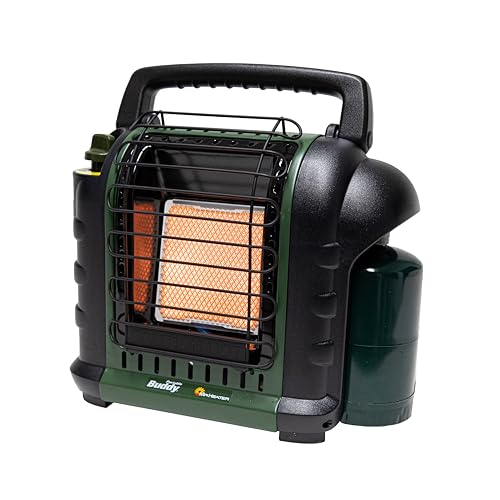
- 100–250 sq ft (a standard bedroom, small workshop, or enclosed porch) — a heater in the 4,000–9,000 BTU adjustable range, such as the Mr. Heater Buddy 4,000–9,000 BTU, comfortably covers this range on its higher setting.
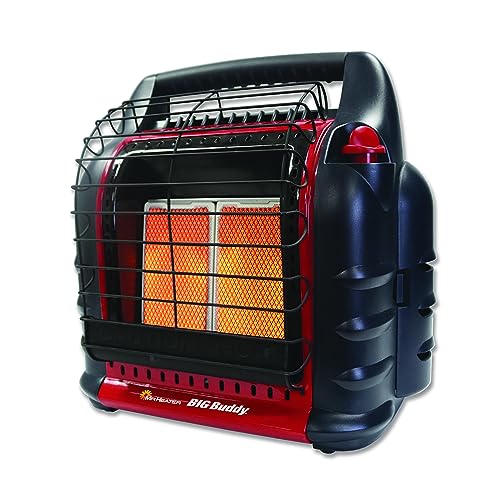
- 250–500 sq ft (a larger bedroom, a single-car garage, or an open-plan room) — this is where an 18,000 BTU heater like the Mr. Heater Big Buddy generally becomes the better fit; a smaller Buddy heater will run constantly without keeping up at this size.
- 500–1,000 sq ft (a two-car garage converted to a workshop, or an open basement) — this is the range where a permanent 30,000 BTU vent-free wall unit, like the Mr. Heater 30,000 BTU Vent Free Radiant Heater, is the appropriate step up rather than running multiple portable heaters.
- Over 1,000 sq ft or poorly insulated — at this scale, a single portable or even permanent indoor-safe radiant heater is often working past its comfortable range regardless of BTU rating, and it’s worth reconsidering whether the space needs central heating or a dedicated forced-air solution instead. Indoor-safe propane heaters are built for supplemental heat in a defined room, not whole-structure heating.
Why "30,000 BTU" Specifically Shows Up So Often
30,000 BTU is the output tier where portable, cylinder-fed heaters stop being a practical option and permanent vent-free wall or cabinet units take over. It’s not an arbitrary number — it reflects roughly the ceiling of what a heater can produce while still meeting the safety margins manufacturers build into an ODS-equipped design, combined with being the point where fuel logistics (swapping 1 lb cylinders constantly) stop making sense and a fixed line or larger tank becomes the more practical fuel source. If you’re specifically looking at a 30,000 BTU heater, you’re very likely sizing for a converted garage, a basement, or a cabin-style space rather than a single bedroom — and that heater is a permanent installation, not something you’ll be moving room to room.
How This Table Compares to Outdoor BTU Guidance
If you’ve also looked at BTU sizing for an outdoor patio heater, you may notice the numbers look different for a similar-sounding space — a covered porch, say. That’s expected, not a contradiction: outdoor and semi-outdoor spaces lose heat to open air and wind in a way an enclosed indoor room doesn’t, so outdoor BTU-per-square-foot guidance runs meaningfully higher than the indoor figures on this page. If your space is a screened porch or a three-season room rather than a fully enclosed interior room, use our porch and screened-space heater guide instead of the indoor table above — the physics, and the certification a heater needs, are genuinely different in that gray-zone environment.
Ceiling Height and Insulation Change the Math
The BTU-per-square-foot rule assumes a standard 8-foot ceiling and reasonably modern insulation. A room with a vaulted or cathedral ceiling has meaningfully more air volume to heat than the floor-area number alone suggests, and an older or uninsulated structure — a detached garage with single-pane windows, for instance — loses heat faster than the baseline assumes. In either case, sizing toward the higher end of the 20–30 BTU-per-square-foot range, or stepping up one BTU tier from what the flat calculation suggests, is the safer starting point. Our sitewide BTU sizing and running-cost calculator lets you adjust for these factors directly rather than relying on the table above alone.
Why Oversizing Is a Real Downside Indoors, Not Just a Cost One
Buying more BTU "to be safe" is a common instinct, but it works against you with an indoor propane heater in a way it doesn’t with, say, an air conditioner. A heater running well above what an enclosed room needs consumes oxygen faster and produces more combustion byproduct in the same sealed space, which is part of why manufacturers publish room-size minimums for their higher-output models rather than leaving buyers to size purely on preference. If you’re between two BTU tiers for your specific room, sizing to the room’s actual needs — using the table above or the interactive calculator — is the better call than defaulting to the bigger unit.
Multiple Small Heaters vs. One Bigger Heater
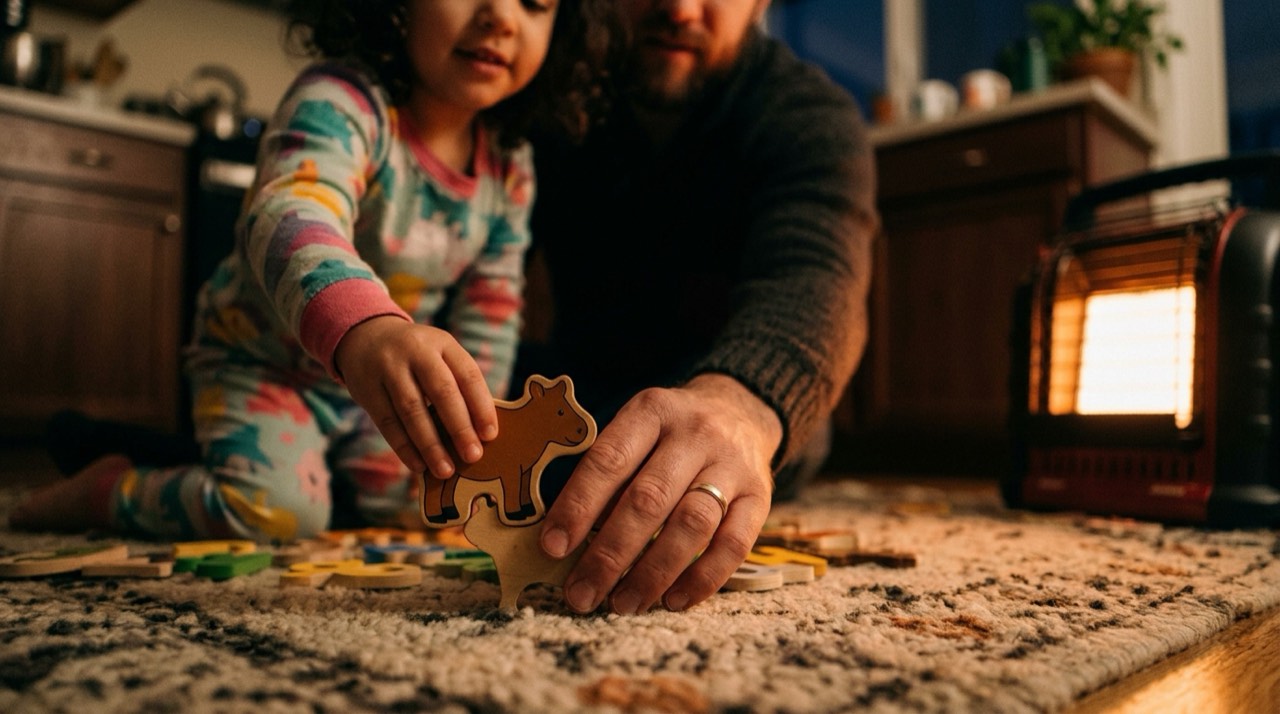
For a two-room scenario — say, a bedroom and an adjoining home office — it’s tempting to buy one larger heater and try to heat both spaces from a central point. Indoors, this generally works worse than it sounds. Radiant heat from a Buddy-style heater is directional and doesn’t travel well through a doorway into a second room, and a single heater sized for two rooms combined is often oversized for whichever room it’s actually sitting in at a given moment. Two smaller, correctly-sized heaters — one per room, used as needed — are usually the more effective and more easily ventilated approach than one heater sized for the combined square footage.
What to Do If Your Room Doesn’t Fit Neatly Into a Tier
Real rooms rarely match a table exactly. If your space falls between two tiers, an adjustable heater with a range spanning both — like the 4,000–9,000 BTU Buddy, which covers everything from a small bedroom up through a mid-size room on its high setting — is generally a safer bet than a fixed-output heater sized to the smaller end. That flexibility lets you run the heater at the lower setting on mild days and step up only when the room actually needs it, which also stretches fuel life. See our running-cost guide for how BTU setting affects tank life specifically.